February 22, 2026
February 22, 2026
Gela, Sicilia, Italia
This morning, we are heading to Piazza Armerina to visit a Roman Villa. First the confusion, where we are going isn’t a Piazza (square) named Armerina, it is a town. In this case the term “piazza” acts as an identifier for a “place” or fortified settlement. No literal translation here. While significantly older, the commune was “re-founded” in the 12th-century with its name evolving from its location and history, without any reference to being a public square.
What does Armerina mean? Is it a person's name? The is probably of Italian or Sicilian origin. It is possible that it was the Latin term for the area, perhaps referring to the historical significance of the area. Perhaps agricultural, or trade related or defense or arms production related, no one knows. There is also an interpretation as a feminine given name reflecting someone of a studious or philosophical nature.
Before the unification of Italy (prior to 1862) the city was simply Piazza. It was probably developed in the 11th-Century during the Norman domination of Sicily. The area around the commune has been inhabited since prehistoric times. Remains and artifacts of old settlements and a necropolis from the 8th-century BC have been found in the area. The city apparently flourished during the time of the Roman Empire, as evidenced by the Roman villa we are visiting today – Villa Romana del Casale.
The site of the Villa Romana was probably occupied long before the Roman Empire. The villa sites on the southern slope of Mount Mangone in a valley with good water source. There was a villa here as early as the 1st-century AD. There is evidence of a “Villa Rustica” existing from the late 1st-century to the early 2nd-century AD. It is evidence by the drystone walls or walls cemented with mud. There was a factory of some sort, probably ceramics, a living area that included a thermal structure from the 3rd-century below the 4th-century gymnasium.
The largest part of the villa was probably constructed in the 4th-century. Now let’s put this into prospective. The first two centuries of the Roman Empire was known as the Pax Romana. It was stable and prosperous. The Empire reached is zenith territorially about 117 AD when the decline began. The 3rd-century had a 49-year crisis that threatened its very existence due to civil war, plagues and barbarian invasions. The civil was ended during the reign of Diocletian who ruled from 284 to 305 AD. This is the point at which the Empire was split into the Greek East and the Latin West, and just before the first Christian emperor Constantine the great.
Somewhere at the end of the 3rd-century and the beginning of the 4th-century is when the Villa Romana del Casale of Piazza Armerina was built. Calling it a villa is probably not actually correct; it is more of a complex than just the living quarters of a high ranking or even noble Roman. That is one of the problems, just who built it, what was their rank, and even why here? Questions which will probably never get a definitive answer.
The Villa Romana del Casale is often referred to “a miniature city mirroring the power of Roma.” Compared to the villas and homes we have seen in Pompeii and Herculaneum this place is massive. The central house or domus is of the traditional rectangular. It has the traditional key components of a compluvium and impluvium which are designed for the water harvesting, lighting and cooling. The compluvium is the square opening over the central courtyard, where the roof is configured to allow rainwater to flow toward the center courtyard, while also providing ventilation and natural light to the center of the house. In the center of the courtyard, or atrium, is the impluvium which is a shallow, marble-lined basin to collect the rainwater. We couldn’t see it but there was probably an underground cistern to hold that rainwater.
The the smaller homes in Pompeii there are rooms, one deep, lining the atrium. These rooms where used for banquets, meetings, offices, and sleeping. Here on one side the rooms are, on the north side, two deep. Meaning there is an anti chamber followed by an additional separate room. One of the rooms even had a third room, which was designated in the signs as the kitchen. On the east side of the villa is a long corridor and a large basilica or audience hall. This was probably for formal gatherings or audiences with the dominus, aka master of the house or lord. He, and it was a he, was also called the paterfamilias, the one who held legal authority over the family and property.
The basilica, nothing to do with a church, probably comes from the Greek term stoà basilikè, meaning “royal space’, is where the dominus would hold official meetings. In a town or city, like Pompeii this was located near the Forum, a public part of the city where business and commerce were discussed. The fact it is built into the or is part of the villa most likely gives the villa a more significant standing than just a domus or home. The basilica is huge, measuring nearly 30 meters by 13 meters, about 100 feet by 42 feet, meaning it was 390 square meetings or nearly 4,200 square feet. The end furthest from the entrance is raised and a semi-circle with a domed roof, giving it the impression of a throne room.
Next to the basilica is another apsidal room, but much smaller, measuring only 8 x 7 meters. It has the same rectilinear space with a a semi-circle area at the far end. It is theorized that this was used by the dominus as a diaeta or cenatiuncula, or perhaps a library. In English that means a small room for leisure, seclusion, or resting, or dinning room.
On the south side of the atrium are several other “services” rooms one of which is a smaller apsidal room known as the diaeta of Orpheus. These were probably official reception rooms for the public. Just outside of the villa, is the Ovoid Peristyle. A large monumental courtyard housing fountains and nymphea which was used to welcome visitors, and problem to impress then, amount pergolas and multiple water features. At the east end of the Ovoid Peristyle is a three-apses Triclinium. In this triclinium, next to the basilica, is the most regal and eloquent hall measuring about 12 meters square. Banquets and panegyrics, public speeches, probably enlivened this room. It would have been furnished with sofas and tables set with food during events.
Now the first areas we saw were the bathhouse. The tepdarium, calidaria and the frigidarium. The three parts of the traditional Roman bathhouse. Following that were the strigil room and the double-asked gymnasium. These were things you would find in a public bathhouse, not generally in a private residence. The gymnasium for example was 22 meters long and 6 meters wide (75 x 19 feet, or nearly 1,400 square feet). There is both a “public” entrance from the south and a private entrance for the dominus’ private quarters on the north. This is right next to it is a porticoed courtyard, though less impressive the the one near the Ovoid Peristyle. And interestingly this is right next to the porticoed latrine which is accessed with out entering the domus proper. This latrine could probably seat 20 people, and had a deep channel to wash way the sewage.
So, you should get the idea, as we did, that this “villa” is unusual is it size and rooms. It appears to combine a noble residence with many of the attributes of the public bath, latrine and forum. This maybe because those things didn’t exist here, no evidence has been found of another city, thus giving the idea of a miniature city mirroring the power and grandeur of Rome. It also indicates that the dominus or master of the house, must have been very wealthy and influential. Some have suggested his was a consul or pro-consul of Roma, the highest elected official.
He may also have been a proconsul, a former consul, appointed to govern a senatorial province, wielding administrative, judicial, and often military authority on behalf of Rome. Sicily was established as Rome’s first province in 241 BC. It was governed by a proconsul with praetorian powers and, because it was peaceful and required no legions, remained under senatorial control. Sicily was a critical agricultural base and a major source of grain for Rome. It would have been led by a proconsul and, usually, two quaestors. But, who was he?
Now besides the grandeur of the villa what makes Villa Romana del Casale unique? That part is easy – the mosaics. The floors are covered with mosaics. Many of which you have probably seen without knowing that they came from here. It is these mosaics which has made this site a World Heritage site since 1997. “The villa resents a unique testimony of the Roman civilization and its extraordinary artistic and engineering skills.”
There is a 300 page book, “The Villa Romana del Casale of piazza Armerina”, which is the official guide, edited by Giada Cantamessa, which was published in 2025, of you want to see photos of all the mosaics and get detailed descriptions of the various rooms. Can’t do that here, besides it would be just copied out of the book. However, like many of the other World Heritage Sites we have visited, you have to be there to truly understand the grandeur and wonder of the site.
The most fascinating and well-known mosaic in the villa is the one in the “second service room of the south master apartment known as the” “Room of the Athletes”. The mosaic depicts female athletes arranged in two registers, showing the female pentathlon. The long-jump, discus, free race, a ball game and a race of wheels. On the left end of the bottom register is a woman draped in golden yellow paying homage to the triumphant athlete with a plan of victory and a crown of roses. This mosaic provided us with a rare, vivid, and highly detained glimpse into the athletic, social, and leisure activities of women in elite Roman society. It is considered one of the most iconic mosaics from the ancient world. It is said it comes from the 4th-century.

Looks like a wall but it is the floor.


After spending three hours at the villa, and frankly not spending enough time, we left to go have lunch. We drove up to the top of the hill above the villa where Piazza Armerina is today. Lunch will be at Osteria Del Conte, which was a recommendation by one of Carmen’s friends, which, surprisingly, is on Via Garibaldi (#77) in Piazza Armerina. Now, like many Italian things, the restaurant closed at 15:00. We arrive shortly after that, but that is ok apparently.
When we arrive the place is fairly full, at least the downstairs. There is a three piece “band” playing and people enjoying lunch. They take us up stairs and put us at a table. This is better than being next to the band as we will be able to hear each other talk. The place is a collection of furniture and bic-a-brac. Different chairs at the tables, different legs on the tables (not on one table but each table is unique. The one thing that have which is very interesting is a motorcycle turned into a bar. Fun.

Yes it was a real motorcycle, albeit one from India
Lunch is also interesting. It starts with a bottle of Alessandro di Camporeale Kaid Syrah 2022 (Monreale DOC). Camporeale is to the northwest in the Province of Palermo. Now read but wait for it. This Syrah has a deep and impenetrable ruby color with bright purple highlights. The nose is rich and elegant, with notes of blackberry, sour cherry and currant as Weill as spicy scents of black pepper and clove. “It is a profoundly Mediterranean and territorial wine that seduces thanks to its outstanding personality and is capable of combining great structure with lively and balanced tannins to achieve a surprising pleasantness.” “Syrah is regarded as the most “Sicilian-style” international grape variety: planed in Contrada Mandranove as far back as 1989, it (is) perfectly suited to the pedoclimatic conditions of this territory.”

That last line had nothing to do with the pedofile Trump. A pedo-climatic zone is an area of relatively homogenous soil type and climate conditions. Using the available soli and climate resources and matching them to the growing of grapes, can contribute to long-term sustainable agricultural productivity. At least since 1989.:>)
We started with four different appetizers. Most of which weren’t even on the menu. The first was Caponata. Apparently, it is the quintessential Sicilian appetizer consisting of bell peppers and eggplant. This was excellent, neither too spicy nor too much like eggplant. The second was a Ragusano DOP Caciocavalio cheese pudding with sautéed chicory. More like a fried flan. Great flavor, kind-of-like, gorgonzola but not that strong. It was served on a bed of a sautéed green vegetable, maybe Swiss chard, at least that was the flavor, perfectly paired.
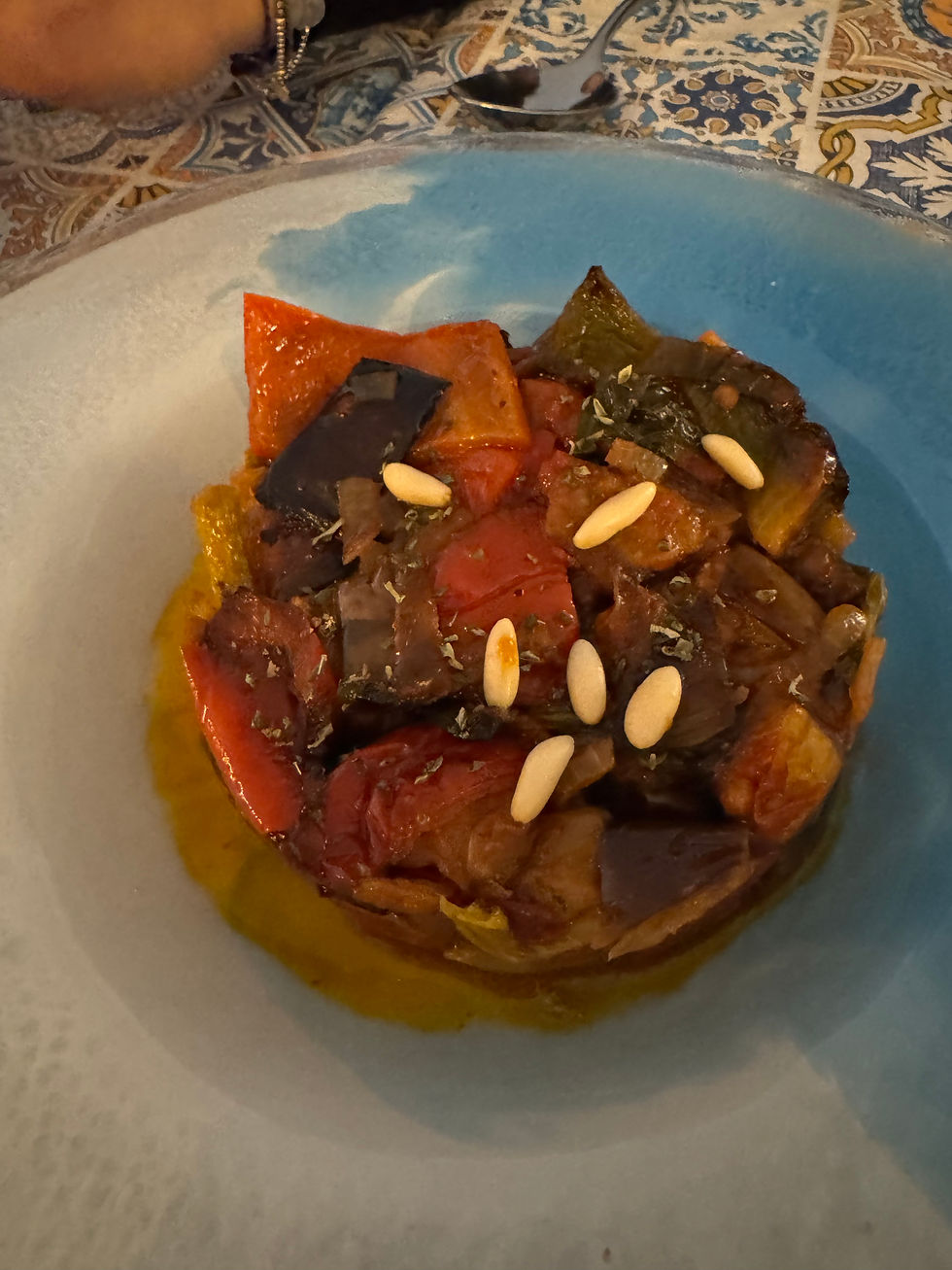
Capnoata

Ragusano DOP Caciocavalio cheese pudding with sautéed chicory

Arancino
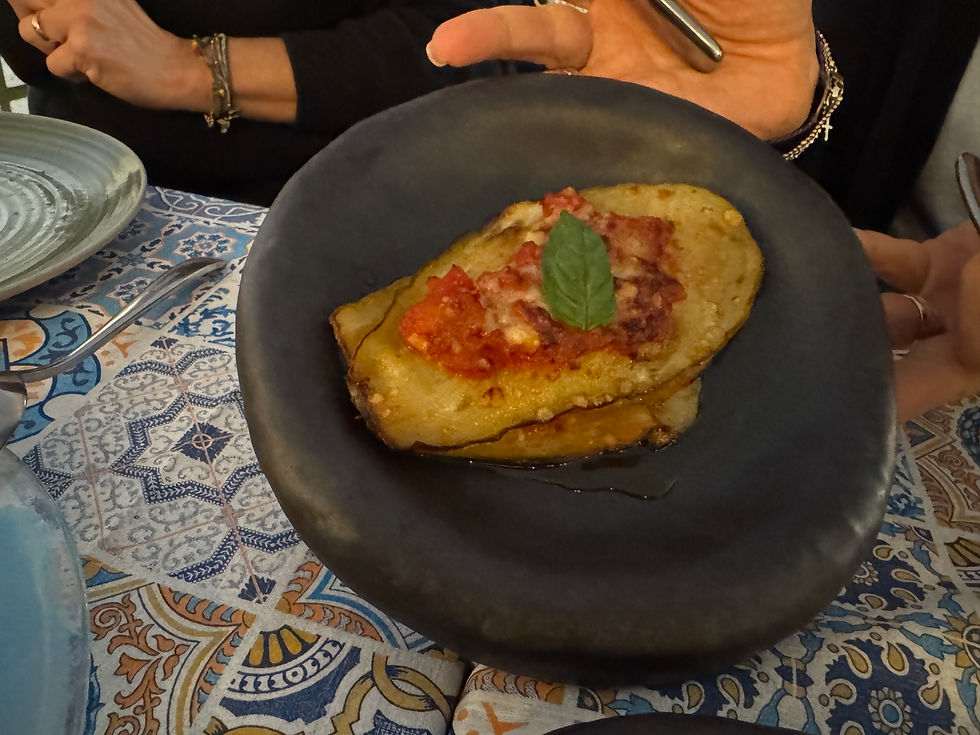
The fourth dish
The third dish was an arancino with white beef ragù and Caciocavallo cheese. Not the cone shaped arancino which is typical of Sicilia, but shaped more like a flan. Interestingly, even though it was the same cheese as the last one, it didn’t possess the same gorgonzola flavor. This was substantially milder. The last one was a bruschetta like dish, but honestly it wasn’t. Hard to describe, and no idea what it was called. However, it was very good.
The main courses were also excellent. Mary and Carmen had the gnocchi gorgonzola dolce, con salsiccia e noci (aka gnocchi with sweet gorgonzola cheese, susage, and walnuts nuts). I choose the pacchetti carciofi, guanciale e Caciocavallo dish (aka pacchetti pasta, a large, tube-shaped pasta from the Campania region, known for its wide hollow shape, with artichokes [currently very much in season in Sicilia], pork cheek, and the Ciciocavallo cheese). Guanciale is the meat from the pig’s jowl or cheek. Guancia is the Italian word for cheek. It is seasoned with salt, pepper and herbs like rosemary, the aged, which results in a rich, fatty, and intensely flavored meat. It is a key ingredient in classic Italian dishes like carbonara and amatriciana and has a depth of flavor which is different from pancetta or bacon. Maria ordered the tagliolini all’uovo con salsiccia, parmigiano e zafferano (aka, egg tagliolini with sausage, Parmesan cheese, and saffron). Yet another excellent dish. We got one canolo which we charged as a dessert.

Mary & Carmen’s dish

My dish

Maria’s dish

Walking out of the restaurant you realized that they were closed. We were the only guests there, the band was packing up and they were mopping the floor downstairs. So much for “closing” at 15:00; it was close to 16:30 when we left. After dinner we walked back to the car and drove back to Gela. We arrived back at the apartment close to 18:00. Back at the apartment we rested, played cards and then called it a night.
Buonanotte e Ciao,
Enrico e Maria


Comments