January 21, 2026
Wadi Rum > Madaba > Mount Nebo > Amman
Again, it is a single task day. Get to Amman and the Fairmont and take a nice long hot bath. We are supposed to stop in Madaba and see a Byzantine mosaic. Then it is on to Mt. Nebo. Mt. Nebo is the place, according to both Jewish and Christian traditions were Moses stood and looked out at the promised land, which he would not be allowed to visit. It is believed that Moses was buried, by God, on Mt. Nebo, although no one has every found his tomb. Of course, for centuries even looking for his tomb as forbidden.
I am up early enough to see the sunrise at 06:10. They sky is clear now, and you can see a lot more stars that you can see anywhere with significant light pollution. They are quite beautiful. There is a shower in the bathroom, but hot water was completely elusive. Alone I brave the cold and walk up the hill to the dinning room for breakfast. There is no cappuccino here, machine made or otherwise. There is coffee with hot milk, which will have to suffice this morning.

One of the geodesic domes
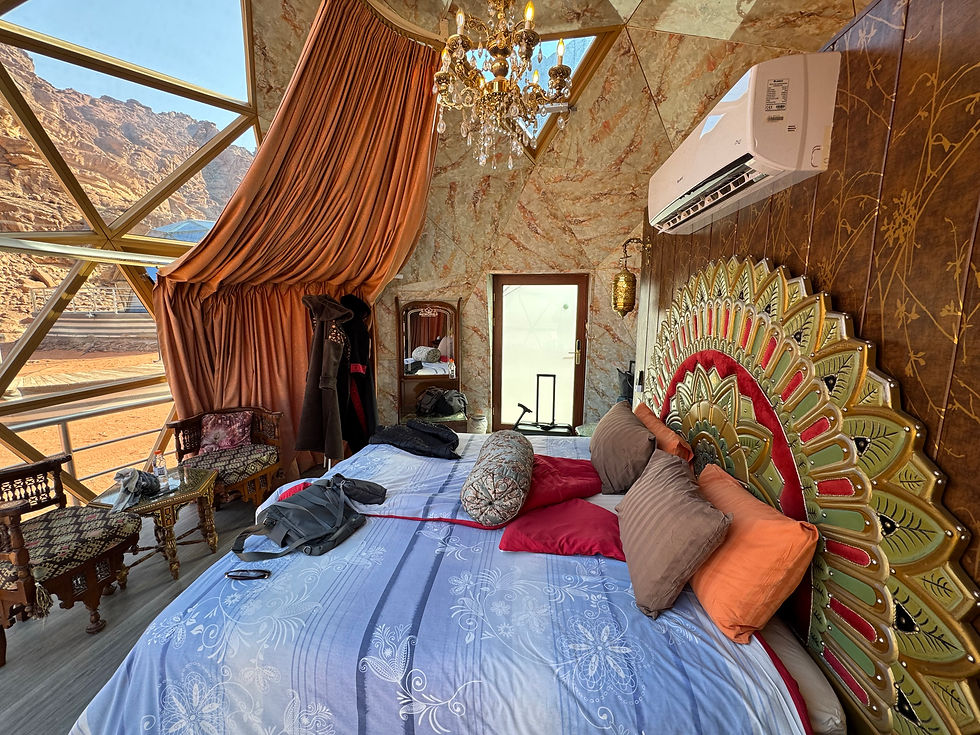
The inside of our geodesic dome

A second shot of the inside of our dome
The breakfast layout is buffet, but they do have an omelette station. I ordered an omelette with cheese, bell peppers and spicy peppers. It was actually very good. I did brave a croissant, which turned out to be a major mistake. They did have pancakes which were made near the omelette station. They were hot and fresh. They had a very good thick-cut orange marmalade which was very good on the pancakes. I was able to take a coffee with me back to the room for Mary.
I used WhatsApp to let the front office know we were ready have them pick up the bags just before it had gone 09:00. At 09:00 we headed to the reception area, we picked up Harry V on the down. Then the three of pilled into the converted pickup. Mary and I chose to sit inside, Harry V chose to ride in the back. According to the weather app it is less than 4° C (39° F) this morning. The sky is clear and there is just a little wind, but once the pickup got going it probably felt colder in the back. It is just a fifteen-minute ride back to the visitor center where we change vehicles and meet up with Khalil and Sami.
Now we are off the Fairmont in Amman. However, it is about 370 km (220 miles) from the visitors' center to the Fairmont. Khalil says it will be about a seven-hour ride. Our first stop will be lunch. We will be stopping at the Petra Visitor’s Center again. Khalil says that will take us about three-hours to cover the 245 km to the visitor's center. This is the same place we stopped on the way down to Petra. Food isn’t bad, just hoping for something different.
We get to the visitor’s center. Lunch is a buffet again. We make quick work of lunch. Don’t do anywhere near the tourist trinket part of the shop. Just a quick in and out. It, however, had gone 12:30 before we get out.
Khalil says it is another hour until we reach the Greek Orthodox Church of St. George in Madaba. Google maps says it is 77 km (46 miles). It seems like it should take less, but it has to do with the speed bumps on the highway, and once we get into town the narrow streets, people crossing wherever, and those vans that serve as busses stopping randomly.

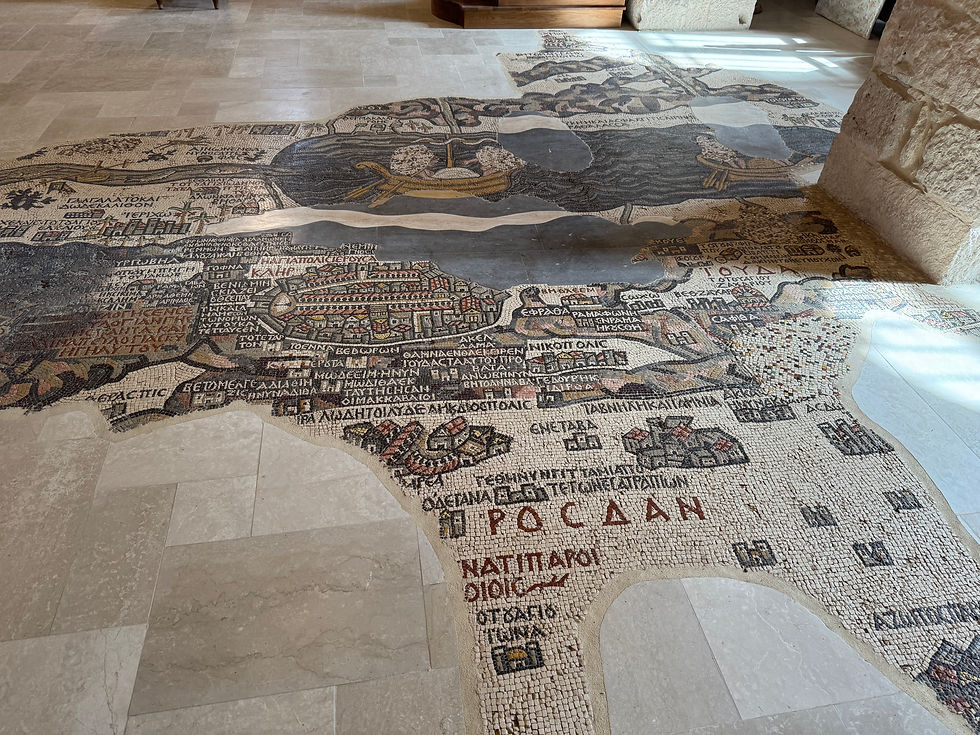


So why are we going to the Greek Orthodox Byzantine Church of St. George in Madaba? We are stopping here to see a mosaic map from the sixth century AD. This mosaic map contains the oldest surfing original cartographic depiction of the Holy Land and especially Jerusalem. The mosaic map depicts an area from Lebanon in the north to the Nile Delta in the south, and from the Mediterranean Sea in the west to the eastern desert.
The map depicts Jerusalem with the “New Church of the Theotokos”. Which was dedicated on November 20, 542. Buildings erected in Jerusalem after 570 are not present on the map. This gives a good date range for the creation of the map somewhere between 542 and 570 AD. The artists are unknown but were probably from the Christian community of Madaba, which was the seat of the bishop at the time.
The ruling Muslim Umayyad Caliphate, in the eighth century, removed some of the figural motifs. The city of Madaba was largely destroyed by an earthquake in 746. The church was subsequently abandoned. Today a relatively new church stands on the site and the floor of the 6th century church is exposed and made part of the new church floor.
It is interesting to see. It looks like they didn’t take literal distances into account when making the map, things appear kind-of jumbled up. But, hey, it is 1,500 years old. If one was studying the 6th century AD Holy Land it is probably a significant piece of work and information.
It is the oldest known geographic floor mosaic in art history. It has been used extensively for the localization and verification of biblical sites. The map played a major role in answering the question of the topographical location of Ascalon, and ancient port city from the 3rd century BC on the Mediterranean.
The map was used to confirm the location of a Nea Church and Cardo Maximus during the 1967 excavation of the Jewish Quarter in Jerusalem. There was other examples as well. Like was pointed out it is if great significance to archaeologists.
Sami thought it would be good for us to visit a place where they demonstrate how mosaics are made. You know one of those places that has clean bathrooms and you are not required to buy anything. We said no! First of all, in the 1960s my mother and I made several mosaic tabletops. It was a 1960s thing. Second of all, we simply aren’t interested in see another tourist demonstration. We have sufficient Catholic guilt; we don’t need any more.
We left the church and drove the 9 km (4.5 miles) to Mr. Nebo. It is cold, although there is no precise reading on the temperature. The wind is blowing so strong my Tilley hat actually blew off. The sky is grey with clouds and there are hints of rain; some current, some recent. We are standing on top of a 1,000 meter (3,280 feet) out cropping with no protection from any side. The biblical historical significant is this is supposedly where Moses got to see into the land promised to the Jew before he died. According to legend he was buried here by God.

View of the Jordan Valley
From here you can see the Jordan Valley, the Dead Sea, and we are told on clear days, Jericho, Jerusalem and even Bethlehem. Sami tries to point out the less clear places, and it looks like there is something there, but exactly what who knows. This has been an active archeological site since the 1930s.
There have been a series of churches and monastic buildings on this site probably for a long, long time. The most interesting are the remains of the fourth century church containing some very well-preserved Byzantine mosaics. Preserved because they were buried under the rubble of an earthquake. The Franciscans have been the ones doing the excavating and restoration. It is a beautiful spot, and if it weren’t for the cold, wind and rain, it would be very nice to spend more time here. However, today it is a brief visit just to see the mosaics in the church.
We get back into the van and head to the Fairmont in Amman some 35 km (22 miles) north of us. It takes about an hour to reach the Fairmont. We say goodbye to Sami and Khalil and head to our rooms. The rooms are very nice here and have a lovely bathtub which can be filled with hot water and some of the the Dead Sea bath salts.
It has been a long car ride today. The weather hasn’t cooperated. It has been cold, probably 3° or 4° C (around 40° F). It is nice to have the warmth of the bath and bed. We separate our clothes out to be laundered. We don’t normally do this but the next couple days will be chaotic and having the opportunity do laundry and having sufficient time for it to dry are unlikely. Not everything, just essentials.
We go to Salt, a restaurant in the hotel for dinner at 18:30. Early enough we are clearly the first people there. Salt is a steakhouse. It could every easily been a steakhouse in Chicago, Kansas City or San Francisco. It was lobster bisque for me, lettuce wedge for Mary and V has Katsu Sando de Boeuf MB5. A Katsu Sando de Boeuf MB5 or Wagyu Katsu Sando is a luxurious Japanese sandwich featuring a thick, panko-breaded, and deep-fried Wagyu beef cutlet (steak) placed between two slices of fluffy, crustless, and toasted white milk bread (shokupan).
The MB5 designation refers to the Marble Score 5, indicating a high level of intramuscular fat (marbling), which makes the meat exceptionally tender, juicy, and buttery, often described as "melt-in-your-mouth". Honesty it was. It was also a large enough portion to be a whole meal by itself.
However, we sent on and had entrees. Mary chose the US Prime ribeye. I chose the Australian Wagyn Striploin with 5+ marbling. V chose a Wagyu beef tartare which was prepared table side. It was very a impressive presentation. All of the food was outstanding. My steak was probably the best. More importantly the actually cooked it medium-rare, not something we have experienced so far on this trip. Everything has actually been heavy on the medium side.
After dinner we called it a night. For me, it was another nice warm bath before hitting the sheets.
Buonanotte e ciao
Enrico e Maria

Comments