October 18, 2026
Updated: 15 hours ago
Sunday
Santiago de Compostela, A Coruña, España > Porto O Grove, Galicia, España > Gaia, Distrito do Porto, Portugal
Well in are into the final days of our first Tauck Tour. Last night’s sleep was a little better than the night before. We walked nearly 11,000 steps yesterday which may have something to do with it. Mary joined Mike and Maddie and I for breakfast. More because we had to have our bags ready for pickup by 08:15, coupled with the fact we need to be on the bus at 09:30.
The program today consists mostly of getting to Porto, which is nearly 300 km (180 miles) from Santiago de Compostela. We re all checked out, fed and on the bus at 09:30. A short while later we are on our way to the Rías Baixas. Now a ría is what is often called a drowned river valley. Baixas or Bajas means lower.
Rías have a deeply indented shape which reflects the way they were formed. Basically they are the area near the mouth of a river at the sea which existed before the rise in the sea level which flooded the valley. In Galicia España we are refer to a series of four estuarine inlets. They are the Ría de Muros e Noia, the Ría de Arousa, the Ría de Pontevedra, and the Ría de Vigo.
It makes sense that we are headed to the Ría due Arousa the southernmost ría which border the Portuguese coast. The unique way the rías are formed leaded to an estuary which is rich in marine life. This has led to an area of fishing, mussel farming, and aquaculture industry. Additionally, the beaches, marinas, cute little seaside towns and all of those water activities attracts lots of tourists. However, it is now October so the thankfully the tourist season is just about done.
We are stopping in O Grove, located on the southern shore of Ría de Arousa in the Province of Pontevedra. We are here to see the bateas, or floating platforms used in the cultivation of mussels, oysters, and scallops. The maritime port here is the begging of the “Mussel Route” where the boat tours, glass-bottom catamarans and sea excursions shove off.
We are such an efficient group, and because it is Sunday near the end of the tourist season and traffic is light, we arrive at dock side nearly a half hour before our appointed cruise into the estuary. It is cold and windy, and Armando must move the bus from the drop-off point, so we stand on the dock shivering waiting for our boat to return.
It is somewhat difficult to believe that there was a tour of the bateas before us, but the boat pulled into the dock just before it has gone 11:00 and unloaded a group of tourists. One the first group as off, we made our way down the gangplank to our boat. Fifteen are twenty minutes later we were out in the estuary pulling up to a bateas where they are growing mussels.
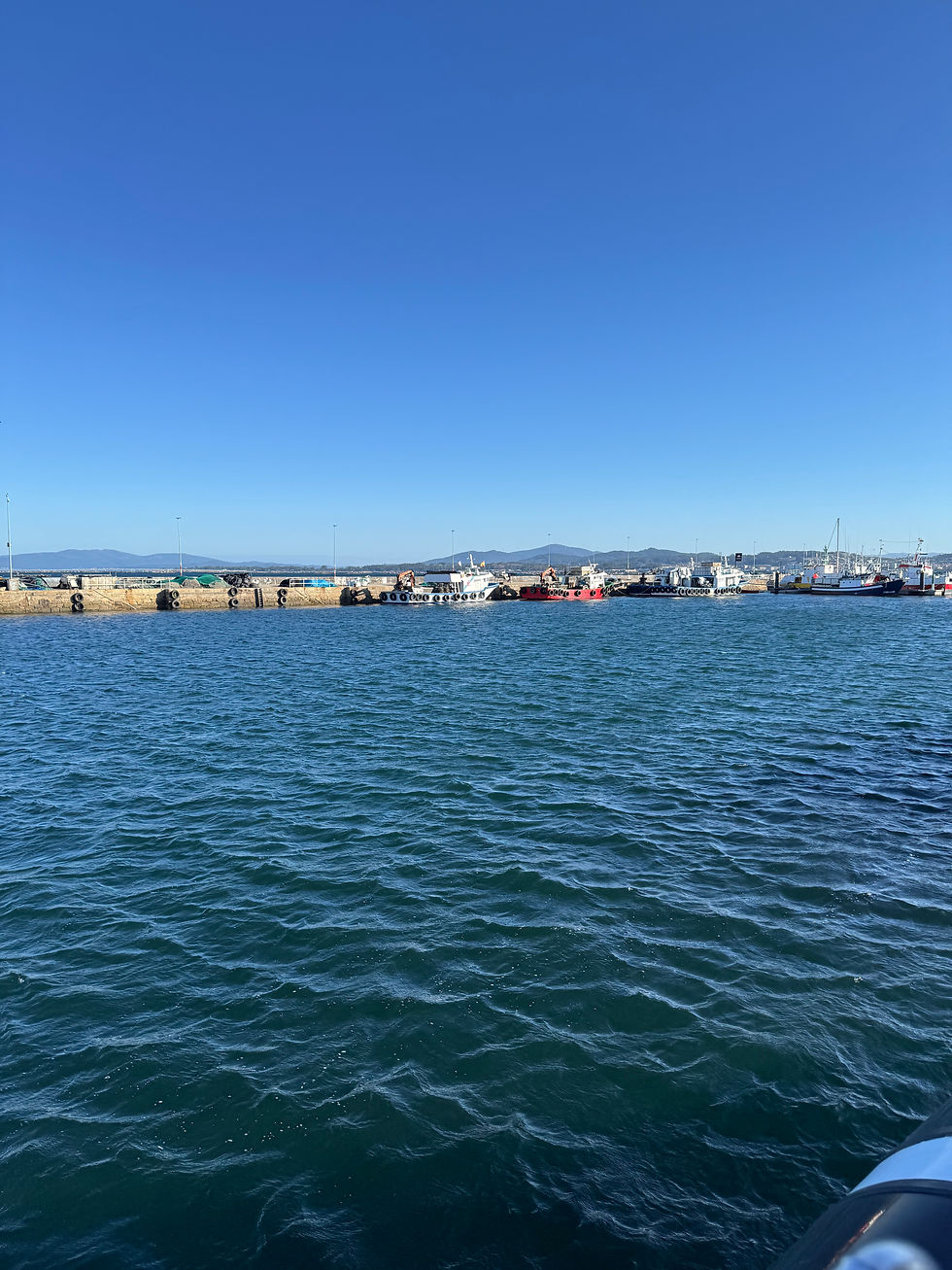
The harbor at the estuary

The floating platforms

Showing us the mussels on the rope

Happy Mike and the three of on the boat
Here they explain that mussel farming is a sustainable aquaculture practice. They grow the shellfish by naturally filtering plankton and algae from seawater without requiring artificial feed, fertilizer, or chemicals. The process beings with breeding the mussels in specialized hatcheries where the baby mussels (called spat) are gathered. The tiny spat are then packed into biodegradable sleeves (often called socks) and attached to ropes.
These biodegradable sleeves are then attached to the bateas (large wooden platforms) and hung into the sea. The mussels grow over a period of twelve to twenty-four months, being cleaned periodically of marine fouling agents, until they reach of marketable size of 8 to 10 cm (about 4 inches). They are then harvested using specialized boats with hydraulic winches. A fully grown mussel line typically weighs between 100 and 250 kg (200 to 500+ pounds).
On board the harvest boat they sort, wash, debris’s (removed the threads/beards) and package the mussels for distribution. They also explained they were trying to farm scallops and oysters, but these take longer are require more work because they do not have the natural clinging ability of mussels.
Now, Uncle Don started farming clams in Humboldt Bay estuary sometime in the early nineteen- sixties. Humboldt bay has had shellfish activities for thousands of years when the Wiyot Tribe harvest clams, cockles, and other shellfish from the bay. White settlers began commercial wild harvest in the 1850s-1870s from the shores near what is today Arcata. By 1873 commercial harvesters were shipping hundred of sacks of wild bay clams to San Francisco’s markets. Uncle Don was focusing on sustainable, steady, structures mariculture. Today, there are several commercial ventures harvesting clams from Humboldt Bay.
We were treated to boiled shrimp and mussels on the boat. The shrimp weren’t particularly fresh, but the mussels were and they were good. It surprised us all that we liked the mussels as much as we did. We are all clam eaters and were surprised how similar mussels are to clams. Back at the dock, up the gangplank, and on to the bus just after it has gone 12:00.
Our next stop on the way to Porto was the City of Viana do Castelo in Northern Portugal. It is a small city, less than 100,000, located at the mouth of the Lima River. It is one of the cities on the Portuguese way of the Camino de Santiago. It was just about to go 14:00 when we stopped. It is Sunday, and nearly everything was closed. This is really a potty break.

The Church in Viana do Castelo

Chafariz de Praça de Rainha
The Queen's Square Fountain (currently known as the Republic Square Fountain) is located in the center of Republic Square, in Viana do Castelo, Portugal. Created by the Porto master stonemason João Lopes, the Elder. Completed in 1554 (dated on a frieze on the base). A Renaissance and Mannerist work, built in granite. It features a pyramidal structure with a circular basin, two superimposed bowls, fluted columns, gargoyles and winged heads that drain the water, crowned by a spire with eagles, foliage and the Portuguese coat of arms. Background: It is part of a group of three similar monumental fountains by the same author (along with the one in Pontevedra, from 1549, and the one in Caminha, from 1551). It has been classified as a National Monument since 1910.
Fernando suggested we needed to try the Portuguese filled donut, without a hole, called the Bola de Berlin. It is apparently the third most-consumed cake in Portugal and is best known as a beach snack. The first and second most consumed pastries are the pastel de nata (a custard tart) and the croissant, respectively. The Bola de Berlin is a fried dough sliced horizontally through the center and filled with a rich, yellow egg-yolk pastry cream called doce de ovos. The entire thing is then rolled in granulate sugar. Yes, we got one. Took one bite. Nice, but nothing “special”.
Yes, Mr. President, the Portuguese bola de Berlin is said to be directly descended from the German Berliner. The same the fried, yeast-doughnut base without a hole, but the differ primarily in the filling or toppings. For you younger folks, there is a urban legend that claimed that President Kennedy called himself a “Berliner” in a speech in 1963 in West Berlin. He stated “Ich bin ein Berliner” (meaning “I am a Berliner”). Linguists and historians note that his phrasing was grammatically correct for a metaphorical statement of identity, and local Berliner’s did not think he called himself a jelly filled donut.
We were back on the bus and on our way shortly after it had gone 15:30. It took about an additional hour and a half to get to our hotel Tivoli Kopke in Porto Gaia. What? Well, we are actually staying in Vila Nove de Gaia, not Porto. It is often considered a neighborhood of Porto, but technically it is a separate municipality directly across the Douro River. It was where all the famous Port wine cellars are located. Here you will find, Churchill’s, Ferreira, Calémm, Poças, Ramos Pinto, Taylor’s, Real Companhis Velha, Sandeman, Graham’s and Cockburn’s. Note I did not include Kopke, although they do make port wine.
The hotel Tivoli Kopke is only two years old. It appears to have been a port wine cellar and warehouse in the distant pass. It is a really confusing hotel, located just above the bustling tourist district located on the edge of the Douro River. Technically, it is across the river from the more famous Riberia. The Ribeira is the historic UNESCO waterfront area at the base of Porto. It is full of narrow cobble streets what wind past merchants’ houses and cafes.
We settled into our rooms. Which took some work to find. The reception is on the fifth floor, we entered through the garage on the first floor. Ok, the streets are narrow and difficult to maneuver, although Armando did a wonderful job. There was no way we could have managed to get to the front entrance on the seventh floor. Sounds strange or what? The problem is that it is built on a steep hillside. Each “floor” is actually on a ground level.
The room is nice. The bed comfortable. Very strange layout. Location feels strange. It is long walk down lots of stairs to get to the river front area where all the activity and restaurants are. It is a much longer walk back up to the hotel.
So, anyway, we are here to visit Porto. Porto is a coastal city here in northwest Portugal. It is known for its stately bridges and port wine production. On the opposite shore of the Douro River is the medieval Ribera (riverside) district with narrow cobbled streets. We will go there tomorrow and tour in the morning.
We were ready for dinner by the time we finished unpacking and getting the room organized. We met Mike and Maddie and headed down the hill to the Mercado Beria-Rio. Fernando pointed this out to us as a place for a quick bite. He said it was a vibrant, modern food and drink market. It was apparently a fish and produce market dating back to the late 19th century. It was converted to an indoor culinary space featuring about 30 food stalls, wine bars and craft beer stations the central seating.
Using Trip Advisor I had booked a dinner reservation at Steakhouse à Brasileria. From the description on Trip Advisor to look and sounded like a restaurant. I booked a table for four at 18:45. I noted in the reservation that Maddie was gluten free. About 17:30 I got a call saying they want to cancel our reservation because they cannot guarantee a gluten free environment. He said they were a small simple restaurant. I talked them out of cancelling the reservation.
Anyway, we arrive at 18:30. The young man that called me was still setting up the tables and chairs outside. The “restaurant” consisted of a kitchen of about 300 sq. Feet, and tables and chairs outside. It was on the eastern side of the market. We were hungry and wanted dinner, so we said we would wait.
Maddie, Mary and I agreed to share a steak. Mike wanted nothing to do with us and ordered a beef parmigiana; breaded beef cutlet topped with homemade tomato sauce and melted cheese, with rice and French fries). The three of us ordered the South American Picanha. Picanha is a cut of beef also known as the rump cap, top sirloin cap or coulotte steak. It is by the gram, so since there were three of us, we ordered 1.5 kg.
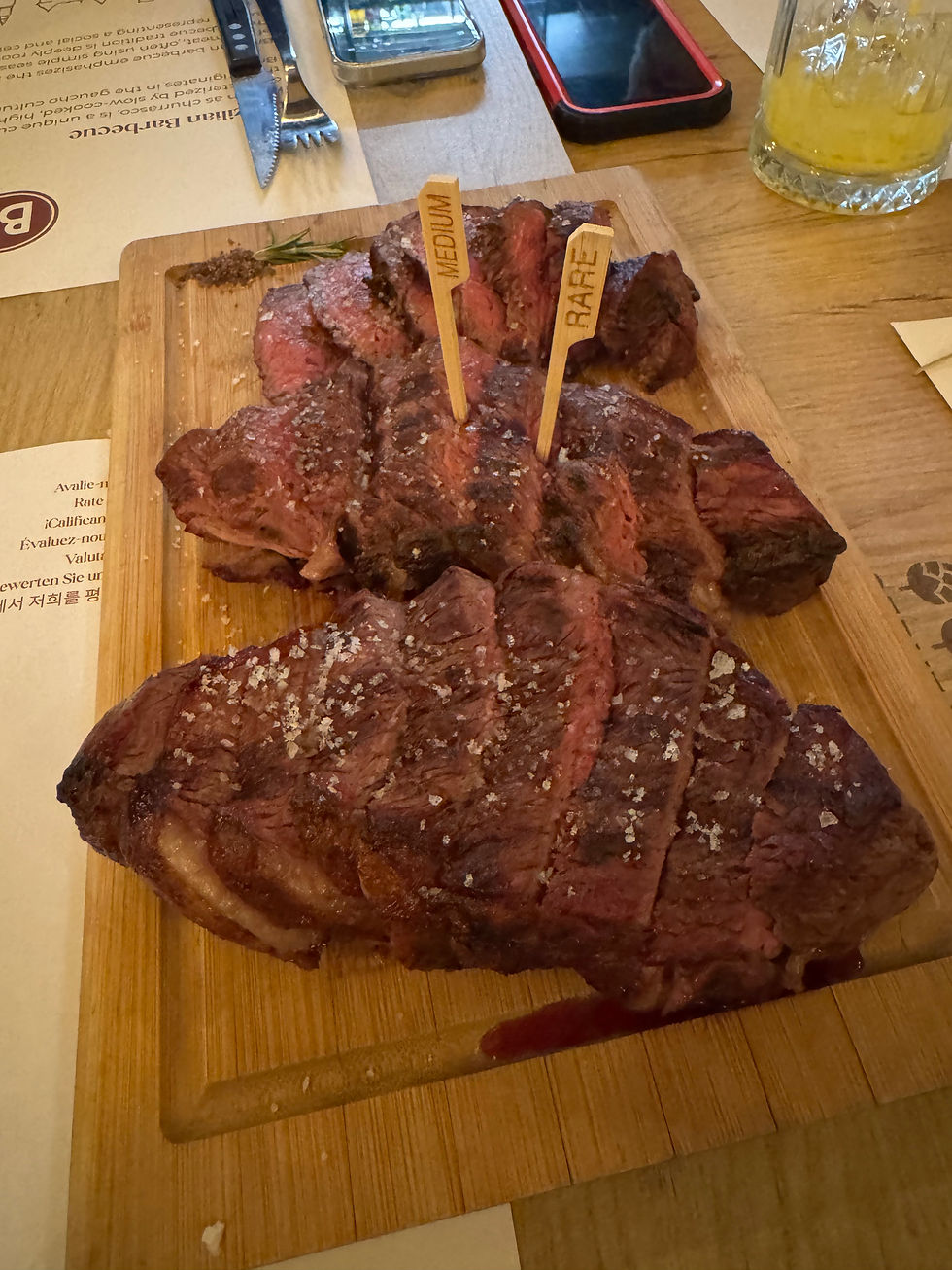
Nice looking steak and we almost ate it all.

Mike’s Beef parmigiana

Trying to decide
Ours is served with rice, black beans, chimichurri sauce and farofa. You get to order to side with all that sop we got grilled corn and Padròn peppers. Farofa is a toasted cassava meal dish. The steak was cooked to perfection and the side dishes wonderful. After dinner it was a hike back up to the hotel, and climb into bed.
Buenas noches y hola - Buonanotte e Ciao,
Enrico e Maria


Comments