October 7, 2026
Wednesday
Le Méridien Hotel, Barcelona, Catalonia, Spain
We started the day by having breakfast with Mike & Maddie here in the hotel in the breakfast room. They were going to see Sagrada Família this morning with their friends from New Jersey. We will connect up with them again at the Tauck welcome party and dinner. There are twenty-six people, including us, on the tour.
We decided to ride the Barcelona Bus Turístic. After breakfast we headed back to the room to get ready for our day out. The weather app says there is a possibility of rain so we grabbed our umbrellas. We headed over to Plaça de Catalunya where we saw the bus stand yesterday.
On the way over we passed the Hard Rock Café. Apparently, we walked right by it yesterday and didn’t even notice. It is right at the end of La Rambla where it meets Plaça de Catalunya. We decided we can come back later and get Grace’s T-shirt and see if they have a collared shirt of me.
We bought out tickets on the north-east side of the Plaça at the Turisme de Barcelona information stand. The did have to choose between the standard GreyLine tour and the “official” Bus Turístic. They have basically the same route. The Grey Line was filling up fast and the upper open-air deck was full, so we chose the Bus Turístic which stops at the same place on the Plaça.
The bus was a two-hour ride though northern part of the city. We saw several fine examples of Art Nuevo homes and palaces. The Sant Pau hospital, Sarai, Monestir de Peoralbes, Palau Reial, the Barcelona football stadium and training grounds, Plaça de Francesc Magia, we drove by the Nobu Hotel we will be staying at in two weeks, and we got off the bus at Sant Antoni on Grand Via Cortes Catalanes.
The former Hospital de la Santa Creu I Sant Pau (Hospital of the Holy Cross and Saint Paul) in the neighborhood of El Guinardó is a complex built between 1901 and 1930. It is one of the most prominent works of the Catalan modernism e architect Lluís Domènech I Montaner. The complex was listed as a Conjunto Histórico in 1978. Together with Palau de la Música Catalana Together with, it was declared a UNESCO World Heritage Site in 1997. It is a huge complex with some whimsical design elements.
Barcelona is actually a city which has absorbed many small cities over time. The Sarrià neighborhood is one of those small cities. The neighborhood is said to still has the small-town air that so enthused the Catalan bourgeoisie in the 19th century: little streets and squares built around the high street, Carrer Major, narrow pavements on streets where neighbors greet one another as they pass by.
Carrer Major" is a Catalan phrase that translates directly to "Main Street" or "High Street" in English. Apparently, you will find a Carrer Major in almost every town and city across Catalonia, Andorra, the Balearic Islands, and the Valencian Community (where it is often spelled Carrer Major or Carrer Major/Calle Mayor). It historically represents the primary commercial, social, or historical thoroughfare of a municipality. The street is usually a wide street which allows for the stores, bars and restaurants to flow onto the sidewalk and street.
Craftsmen and middle classes built their summer residences here, and Sarrià became one of the most prosperous parts of Barcelona. The architecture reflects this splendor in the many houses, many of them Modernista, that can be found in the old town, on Passatge Mallofré or in Plaça de Sant Vicenç.
The Monastery of Pedralbes (Monestir de Pedralbes), otherwise known as the Royal Monastery of Santa Maria de Pedralbesis a Gothic convent. It is now a museum, housing permanent exhibitions on its own art and legacy as well as third-party special exhibitions from time to time. The name of the site in the 14th century was Petras Albas, Latin for "white stones". The original name devolved into the current one. Not much to see as we ride by on the bus, but obviously a large complex of buildings.
The Palau Reial (Royal Palace, although no royals actually lived here) is an architectural complex located in the heart of Barcelona's Gothic Quarter. It served as the residence of the Counts of Barcelona and, later, the monarchs of the Crown of Aragon. It consists essentially of three buildings: the Salón del Tinell, a spectacular ceremonial space featuring blind arcading and a wall that aligns with the ancient Roman fortifications; the Palatine Chapel of Santa Ágata, which houses the Altarpiece of Constable Peter of Portugal by the painter Jaime Huguet (1465)—a masterpiece of Catalan Gothic painting; and, finally, the Palau del Lloctinent, built in the 16th century by Antoni Carbonell at the behest of the King of Spain, featuring a style that bridges the Late Gothic and Renaissance periods.
Plaça de Francesc Macià is a major commercial hub and traffic circle in Barcelona, located at the meeting point of the Eixample, Les Corts, and Sarrià-Sant Gervasi districts. Here the four major arteries of Barcelona connect; Avinguda Diagonal, Avinguda de Josep Tarradellas, Avinguda de Pau Casals, and Carrer del Comte d'Urgell. It was designed in the early 1930s by architect Nicolau Maria Rubió i Tudurí. It was originally inaugurated in 1932 as Plaza de Alcalá Zamora, it went through several name changes before receiving its current name on December 20, 1979, honoring Francesc Macià (1859–1933), the military officer and first President of the Generalitat de Catalunya. If you haven’t figured it out yet – Catalunya and Catalonia are the same thing.
We got off the bus at the Sant Antoni stop on Grand Via Cortes Catalanes. The Mercat de Sant Antoni is an historic 19th-century iron market designed by Antoni Rovira i Trias (and reopened after major renovation in 2018) is the social and commercial heart of this neighborhood. We were hungry, it was nearly 13:00, when we stoped at a small corner restaurant – Ordesa.
We got a couple bottle of water. We ordered a tapa of different salami to eat while we waited for our paella. Mary got a vegetable paella and I got a meat, chicken and beef, paella. It did not look like or taste like the paella my mother made in the 1960’s. It was ok, but nothing to do twice.

Tapas of various meats

My meat paella
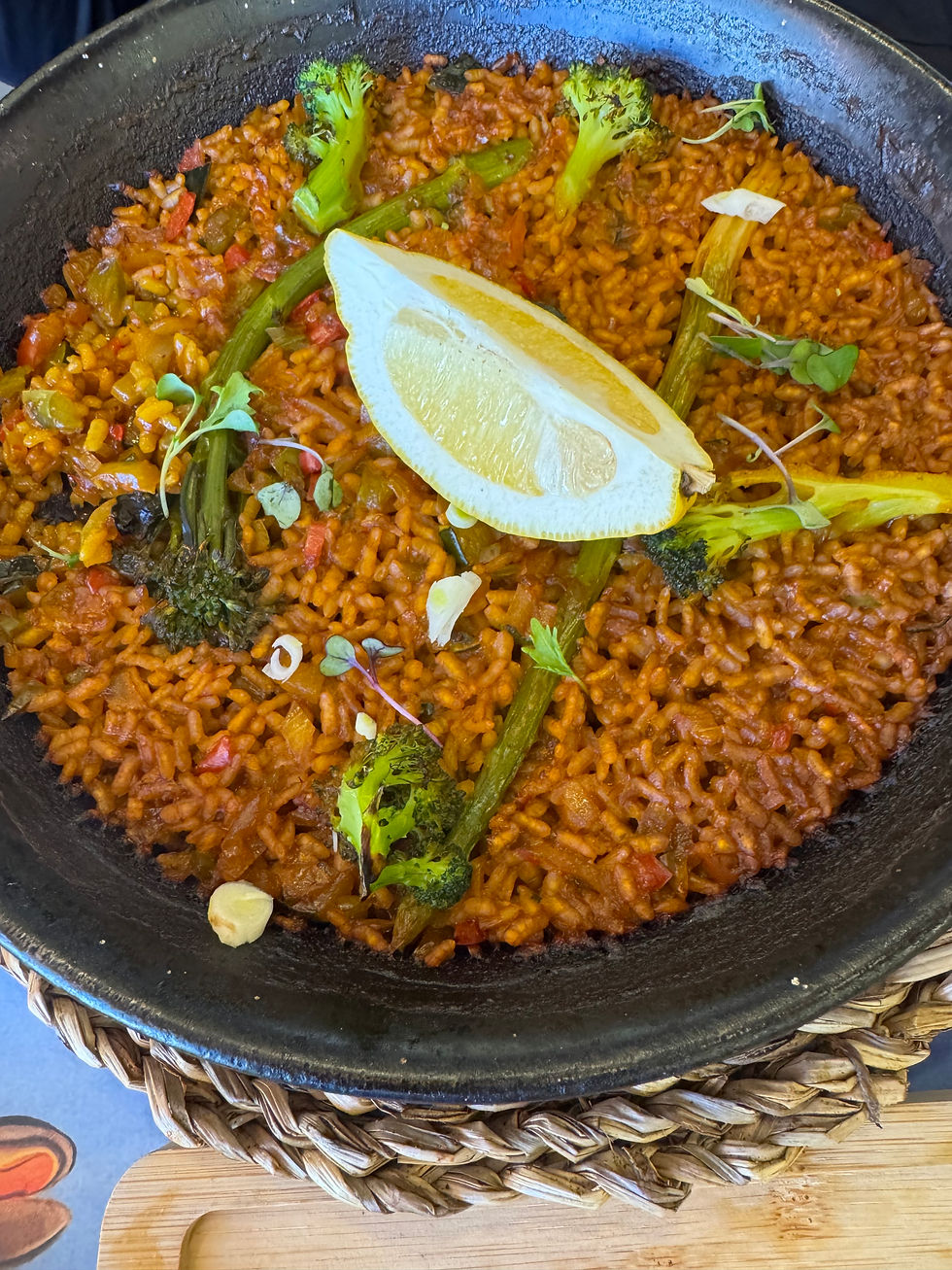
Mary’s paella
After lunch we walked down the Grand Via Cortes Catalanes to Plaça de Catalunya. We stopped at the Hard Rock and got Grace a t-shirt and a collared short for me. Then we walked back to the hotel and rested up until the welcome dinner at 18:30.
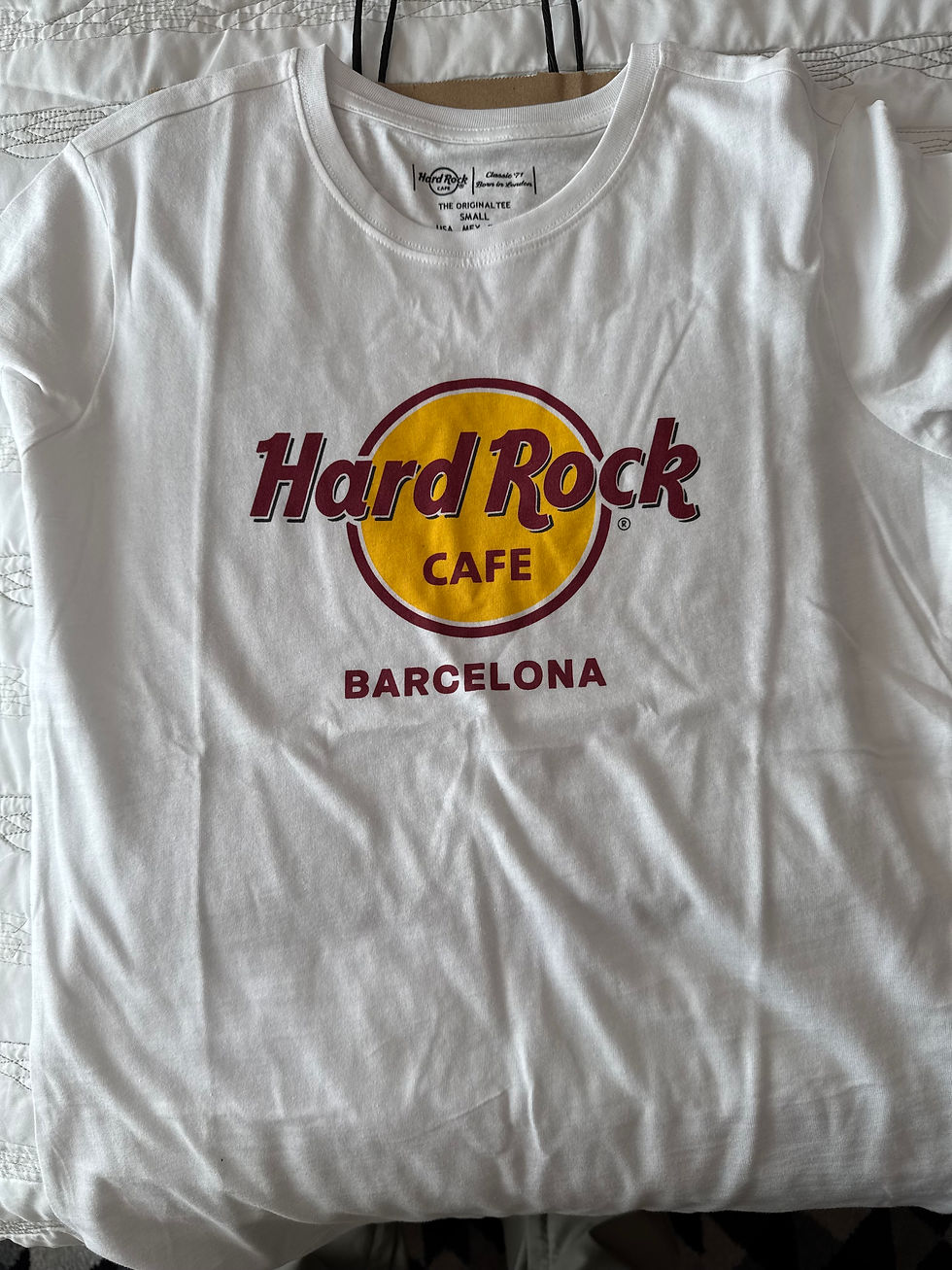
Grace’s t-shirt
Although the itinerary said 18:30 dinner did not start at 18:30. We were the first to arrive at “dinner”. We got there at 18:30 as directed. The dinner started with aperitivi and wine. We talked with some of the twenty-six people on the tour. We aren’t the youngest, abut we are also not the oldest. The oldest maybe Roger at 81. Maddie probably has the record for the youngest.
Dinner was ordered were taken from a limited menu, but enough its there were choices. It was after 20:00 that dinner finally arrived. My then we really didn’t care anymore. People started leaving about 20:30. We finally left at 20:45.
Breakfast opens at 07:00 tomorrow and our tour of Barcelona starts at 08:20. So it is good night.
Buenas noches y hola - Buonanotte e Ciao,
Enrico e Maria


Comments