September 12, 2026
September 12, 2026
Saturday
Praha, Czech Republic
The health app on my phone suggests that I slept six and a half hours last night, but that I was up and down all night. It produced a sleep score of 70. That is a sleep score of “OK”. However, I feel very well rested this morning and ready to take on our Context all day tour of Kutná Hora.
The breakfast room was fairly quiet. The person behind the bar hadn’t even turned on the espresso machine yet when I arrive at 07:00. This forced my to use the machine in the lobby to make my morning cappuccino. Machine made cappuccino is always a disappointment and this proved to be correct as usual. Better than nothing but not by much. A cappuccino from the machine with an extra shot of espresso helps.
Breakfast is a little about average. The standards, scrambled eggs, sausage, sliced cheeses, sliced meats, baked beans, cereal and jam. Fresh fruit was available in the bar area. They did have one thing above average and that was freshly baked bread. It was still warm from the oven.
Mary joined me for breakfast just before it went 08:00. We finished up breakfast and headed back up to the room to finish getting ready for the day. We were back out front of the hotel just before it had gone 09:00. Our guide, Robert, who we had seen sitting on the bench in the park across the street, apparently recognized us immediately after we exited the hotel. He came over and asked if we were Harry & Mary.
After out introductions we walked around the old town a little bit asking questions about the architecture of the buildings. Turns out that architecture is one of Robert’s disciplines. He was able to tell us a great deal about history and architecture of the area. We are staying just outside what was the Jewish Ghetto here in Praha.
Our driver and Mercedes van arrived just after 09:00 and we were off to Kutná Hora. So, why are we off to Kutná Hora? Kutná Hora was designated a UNESCO World Heritage Site in 1995 because of its outstanding architecture and its influence on subsequent architectural developments in other Central European city centers. The historic town centre is also protected as an urban monument reservation, the fourth largest in the Czech Republic.
The three most important places in this Central Bohemian town are the Sedlec Abby, Sedlec Ossuary, The Church of Saint Barbara, the patron saint of miners, and the Italian Court. The Sedlec Abbey is, interstingly, located in the Sedlec suburb of Kutná Hora along with the Church of the Assumption of Our Lady and Saint John the Baptist. The monastery was founded in 1142, but most of the monastery complex was built in the second half of the 13th century. The large complex had an area of 20 ha (49 acres) at its peak and belonged to the largest and wealthiest monasteries of the Czech lands in the Middle Ages. At the turn of the 17th and 18th centuries, the church acquired a unique Baroque-Gothic form according to the design of the architect Jan Santini Aichel.
Jan Blažej Santini Aichel was born in Praha, Bohemia (now known as Prague pub the Czech Republic) on 3 February 1677 to a Czech mother and Italian father as their oldest son. Jan was born small, hunchbacked and partially lame. His father and grandfather were respectable stonemasons who had moved from Italy to Praha in 1630. At the age of 19 or 20 Jan started to travel and gain experience in architecture and stonemasonry.
He journeyed through Austric and ended up in Roma where is worked Francesco Borromini a leading figure in Roman Baroque architecture. He returned to Praha in the early 1700’s and opened his architectural practice in 1703. He gained the status of burgher of Praha in 1705. Burghers ranked below the mobility and clergy, but well above peasants and day laborers. It ment that you were a wealthy merchant, master craftsman or a professional.
Near the abbey is the Church of All Saints, is the Sedlec Ossuary. The ossuary was a cemetery chapel, built at the end of the 14th century and modified in the Baroque style at the beginning of the 18th century by Jan Santini Aichel. It is estimated that the ossuary is decorated with bones of more than 40,000 skeletons that belonged to those who died from plague epidemics, in the nearby silver mines, in the Hussite Wars, or people who simply wanted to be buried in such an important place as Kutnà Hora.

The unique decoration of the Sedlec Ossuary, is a chandelier composed of all the large bones of the human body, was created by the carver František Ring. The cemetery around the church was used during the 13th–16th centuries. Today it is an archaeological site where 30 mass graves have been identified.
Saint Barbara's Church (Chrám svaté Barbory in Czech) is a Roman Catholic Church in the style of a cathedral. It is one of the most famous Gothic churches in central Europe and it is a UNESCO World Heritage Site. Saint Barbara is the patron saint of miners (among others), which was highly appropriate for a town whose wealth was based entirely upon its silver mines. It is located outside the Old Town district, behind the Jesuit College. The area was formerly outside of the town.
Construction of Saint Barbara’s began in 1388 but because work on the church was interrupted several times, it was not completed until 1905. The first architect was probably Johann Parler. Work on the church was interrupted for more than 60 years during the Hussite Wars and when work resumed in 1481, Matěj Rejsek, Benedikt Rejt and Mikuláš Parler, assumed construction responsibility. The original design was for a much larger church, perhaps twice the size of the present building. Construction, however, depended on the prosperity of the town's silver mines, which became much less productive over time. So, in 1588, the three-peaked roof had been completed, and a provisional wall was constructed. A little later it was occupied by Jesuits who gradually changed the structure into Baroque style, though parts of the church still remain in Gothic style. The final process of repair and completion took place at the end of the 19th century, under architects J. Mocker and L. Labler.
Originally there were eight radial chapels with trapezoidal interiors. Later on, the choir was constructed, supported by double-arched flying buttresses. Internal points of note are the glass windows, altars, pulpits and choir stalls. Medieval frescoes depicting the secular life of the medieval mining town and religious themes have been partially preserved.
The Italian Court in Kuntá Hora refers to the royal mint and residence of the king during his visits to the silver mines. Because of the silver mines it was the centre of the state economic power. The history of the building itself reaches back to the late 13th century, when it served the function of a town castle: a safe storehouse of the silver ore and it was an important part of the town fortifications. It was separated from the town itself by moats, which survive in the lower section as cellars; the water in the moat also protected the castle from fires.
In 1300 the reformation of the mints by King Wenceslas II moved all of the previously functioning coinage-works in Bohemia to the Italian Court in Kutná Hora. Coins of a unified value "the Prague groschen" began to be struck. According to Robert this was important because prior to this, the coins were struck at multiple mints are varied greatly as to silver content and size. The Prague groschen set the first reliable standard.
During the 14th century the castle was completely rebuilt; although the greatest flourishing of the building activity came at the end of the century, under the reign of Wenceslas IV. The reconstruction was done by the workshop of Peter Parler which was then completing the church of St. James and starting his work on Saint Barbara’s Church. The royal mint and the office of the supreme master minter came to an end in the 18th century after the great fire of 1770. By this time in history coinage had become more reliable and standardized throughout Europe.
I knew you were going to ask – why was it called the Italian Court? Well, King Wenceslas II brought in specialists from Florence, Italy, who were known as the best coin-makers of the Middle Ages. These experts helped centralize coin production and introduced the stable silver coin - the Prague groschen. Around 1400, the Latin name Curia Italica (Italian Court) or Curia Walachica (Vlach Court) came into use because locals referred to the Italian specialists as "Vlachs".
Before we visited the Italian Court, we stopped at a local hotel and restaurant called Kozlovna Barborský dvůr. Kozlovna Barborský dvůr is a stylish restaurant in beautiful old town surroundings. We sat outside on the terrace because it was such a nice day. They serve mostly Czech cuisine and great beer directly from the barrel; here the barrel is referred to as a tank. Tank beer Kozel 11° is their flagship beer known for its quality. It is produced in the traditional method using Czech ingredients and bears the trademark Czech beer. Yes, I had one and it is very nice.
Ordering was interesting becausee they only had menus in Czech. Fortunately, I had downloaded Czech into Google Translate. Using my phone, I was able to easily translate the menu. I ordered Smažený Kuřecí Řízek, vařený brambor, kyselá okurka, citron (Fried chicken schnitzel, boiled potatoes, pickle, lemon). Mary had the César salát s kuřecím masem, slaninou a parmezánem (Caesar salad with chicken, bacon, and Parmesan). Both where very large portions and tasted very good. With our drinks the total come to CZK 590 (less than $30.)
We reconnected with our car and driver after our visit to the Italian Court and drove back to Praha. We arrived back at hotel at about held past 16:00. We were both tired from the walking and riding in the car, despite the half hour or so of napping on the way back. We needed to do something, or we were going to climb into bed and go to sleep. We went downstairs to the lounge, made tea and played a game of Canasta.
About 18:20 we decided to get some dinner. Probably just an aperitivo. We looked into the bar in the hotel but when we inquired about service the receptionist told us that their bartender was out sick. She could serve us a drink but they weren’t serving any food tonight. So, we headed to the Hotel Maximilian next door.
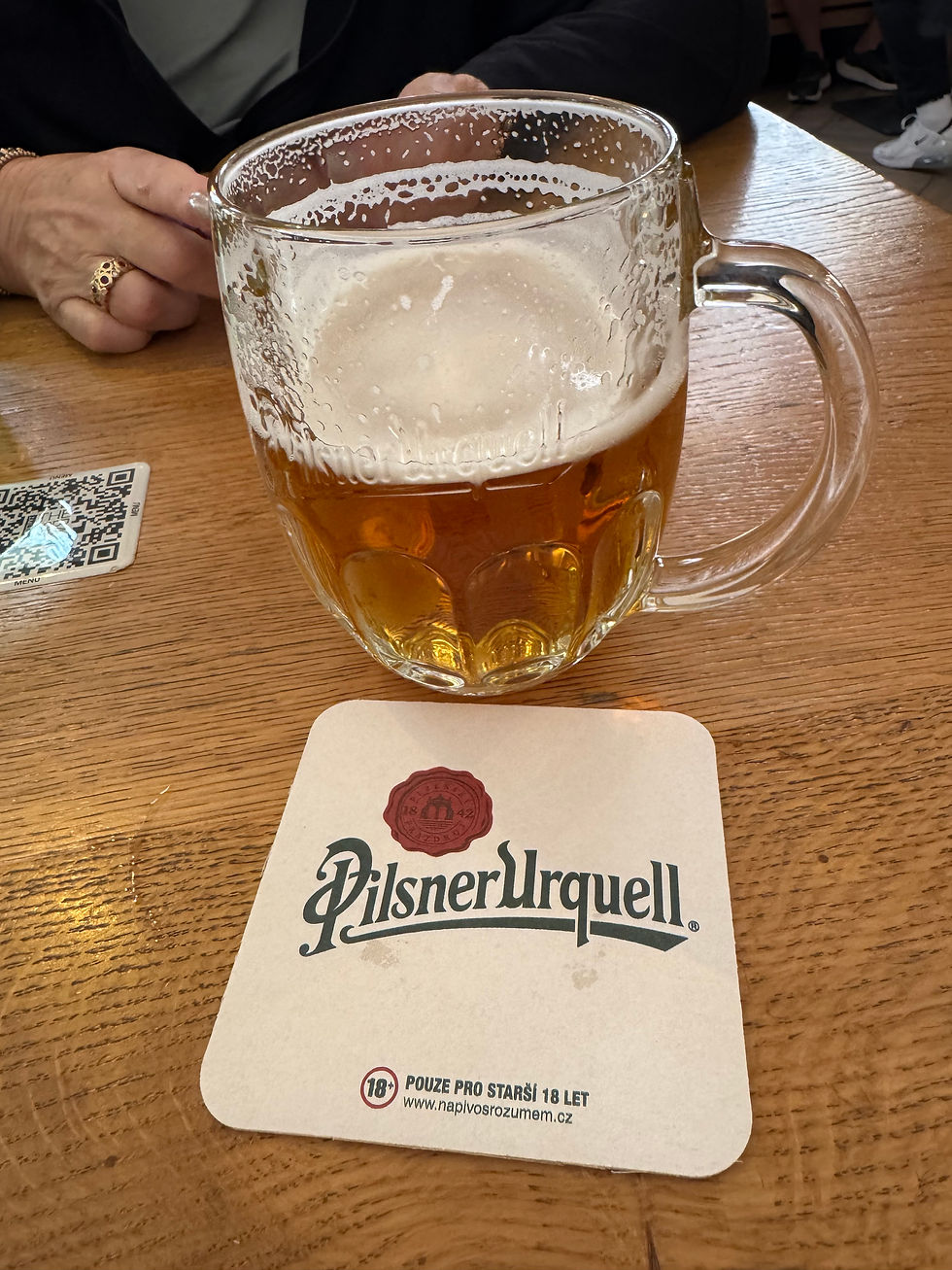
Mary got a glass of Sauvignon Blanc and I got a Pilsner Urquell. To eat, Mary chose the soup of the day – cauliflower. Looking over the menu, one thing really caught my eye – a risotto with prosciutto and melon. It had to be tried. They served straggly made bread and I asked for some very to accompany it. They brought me Brie de Meaux. Brie de Meaux is a French brie cheese of the Brie region and is a designated AOC product. Its name comes from the town of Meaux in the Brie region. Who knew?

Both Mary’s soup and my risotto were wonderful. The sweet melon flavor blended well with the saltness of the cheese in the rice and the prosciutto. It is something we will have to try to make someday.
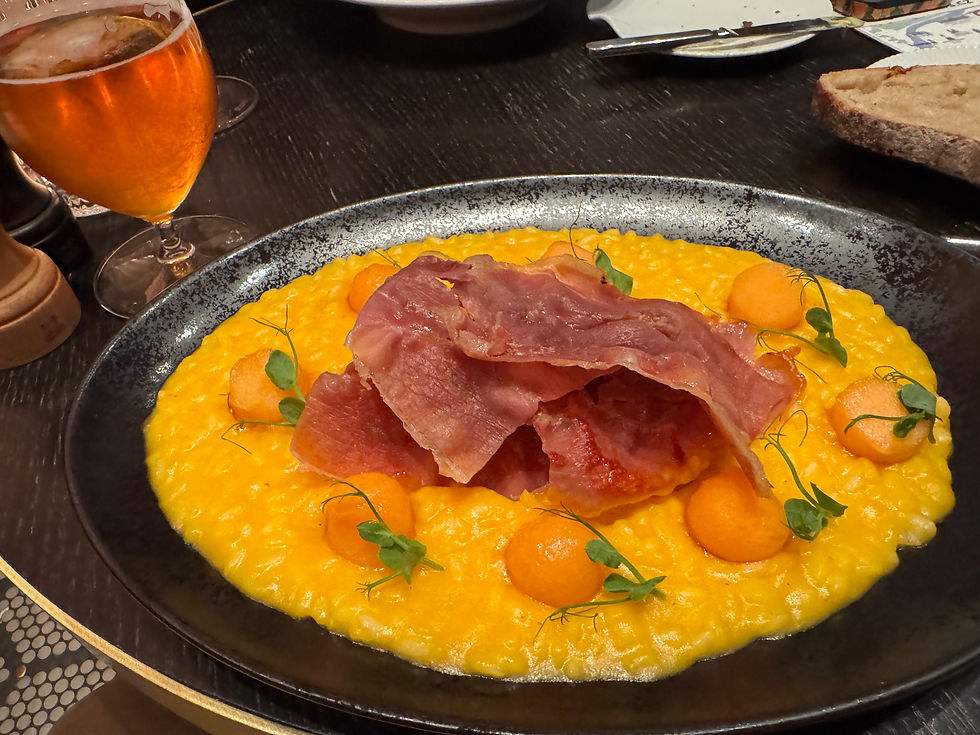
I have included the recipe so I can remember. Melon and prosciutto risotto is a sweet and savory summer dish that balances creamy rice with crispy prosciutto and fresh cantaloupe.
Ingredients
2 cups Arborio or Carnaroli rice
6 cups warm vegetable or chicken broth
1/2 medium cantaloupe (peeled and diced or grated)
3 to 4 ounces prosciutto crudo (chopped or sliced into strips)
1 chopped shallot or small onion
1 garlic clove, minced
1/2 cup dry white wine
3 tablespoons butter or olive oil
1/4 cup mascarpone or parmesan cheese
Fresh basil or black pepper for garnish
Instructions
Heat the broth in a separate pot and keep it at a gentle simmer.
Melt a tablespoon of butter in a large pan over medium heat, add the shallot and garlic, and cook until soft.
Add the rice and toast for about 2 minutes until the edges look translucent.
Pour in the white wine and stir until the alcohol evaporates.
Add the warm broth one ladle at a time, stirring often and waiting until the liquid is absorbed before adding more.
Crisp the prosciutto in a separate dry pan over medium heat for a couple of minutes, then set aside.
Stir in the melon and most of the prosciutto just before the rice reaches al dente.
Turn off the heat and stir in the butter, mascarpone, or parmesan for a creamy finish, then top with the remaining crispy prosciutto and fresh basil.
Dinner cost us 970 CZK or less than $50. It was well worth it. I used my American Express to pay and all looked good. We went back to the hotel. It was still too early to retire for the evening, so I went downstairs for a cigar. While I was out on the patio having my cigar the waitress from next door and the front desk clerk from our hotel burst into the patio. Apparently, the credit card was declined.
The truth is American Express just isn’t generally accepted in the Czech Republic. The waitress apologized profusely for not catching it before we left. I assured her it was ok and handed her 1,000 CZK note to cover the bill and her time to bring it to my attention. She was very happy.
I finished my cigar and headed up to the room. They had called Mary about the bill, but since I locked her in the room, there is only one key, and the door doesn’t close unless it is locked there wasn’t anything she could do. She directed them to the patio.
All is well that ends well. It has been a great day, and it is finally late enough we can head to bed.
Buonanotte and Ciao,
Enrico and Maria

Comments