September 17, 2026
Thursday
Wien, Austria
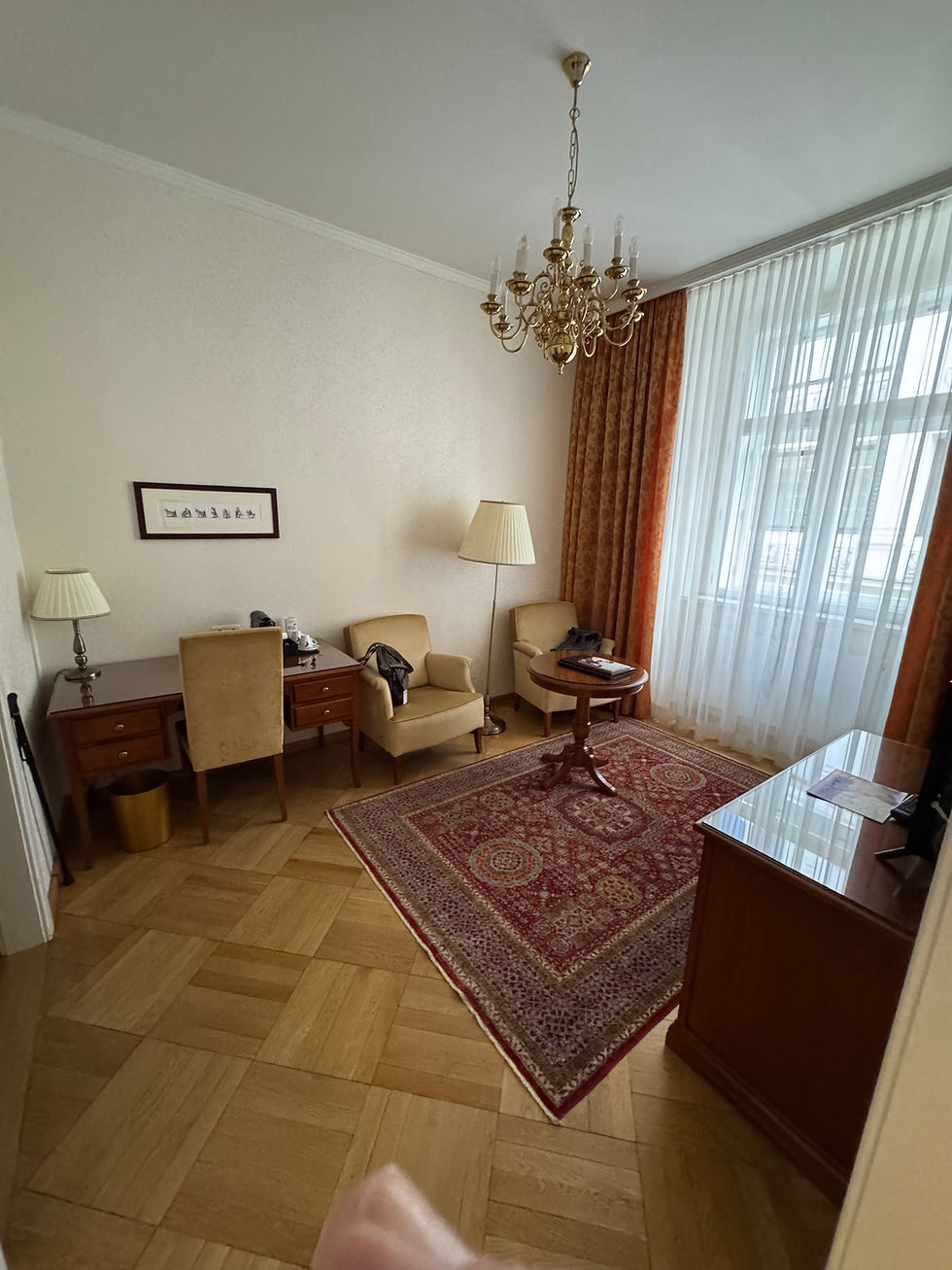
Good morning! A new day and another city and country. Today we have a four-hour Viator Tour called “Fall in Love with Vienna”. It is slated to start at 09:00. The meeting place is only 270 meters from the hotel at the Wien Museum Mozart Apartment.
Finding coffee in Wien at 07:00, well anything before 08:00, is impossible. Nothing is open early in the morning. The streets around the hotel, which is in a pedestrian only area, are filled with delivery trucks of every type. There are a number of coffee houses, they just don’t open until 08:00 or later. The only place open, sadly, was Starbucks.
It is sad for two reasons. First, Wien is known for its coffee. Vienna's famous coffeehouse culture began after the Turkish siege of 1683, when retreating Ottoman forces left behind sacks of mysterious green beans. Popular legend credits the Polish officer Jerzy Franciszek Kulczycki with opening Vienna's first coffeehouse, Hof zur Blauen Flasche, and inventing milk-and-sugar coffee blends. Officially, historical records show that the city's first official coffeehouse license was actually granted in 1685 to an Armenian businessman named Johannes Theodat (Deodato). Starbucks only calls it coffee.
Second, a grande cappuccino at Starbucks in Wien is €5.20. Looking at the menus at several of the coffee shops around our hotel a cappuccino is €1.70. The truth is you can probably get a much better cappuccino elsewhere in Wien for closer to €1.20. The only people who seem to visit Starbucks are tourists, and most of them are probably Americans. Sad.
Just before 09:00 we head to the meeting point for the tour. There are several other there for the tour when we arrive. There is an American couple who don;t show up by 09:00 and the guide has to call them. She arranges to meet them somewhere along the way.
The tour hits all the high points in Wien and a couple more remote places. Most off the Wien is enclosed within the “Ringstrasse” a 5.3-kilometer (3.3 Mile) grand boulevard encircling the historic old town. In the 19th century Emperor Franz Joseph ordered the old medieval city walls torn down and replaced with a grand circular road lined with monumental public buildings and parks.
We took a route out to the ring which lead us through various neighborhoods all of which consisted on 18th and 19th century palaces. Huge monumental homes. Back in the day the upper class had these large palaces. First to show off their wealth. Second because they had to house their staff. It is said that the Emperor had 2,000 staff living with him in his palace.
We saw, at the the outside of, the Votivkirche (Votive Church), a neo-gothic church built by Maximilian to honor some event. It was next to the University of Vienna, where Sigmund Freud taught. We stopped at Café Bierbeisl Einstein, where supposedly Freud and Einstein had coffee, although not together. From there we walked through the Volkspark. Which is a community type garden with a Greek Temple and lots of Roses.
We saw the grand neo-Gothis city hall. With a circus in the park in front of it, obscuring the best views of the building. The Vienna State opera building, the first major work finished on the boulevard. We saw the Burgtheater: Austria’s national theatre. The The Classical Greek styled Austrian Parilament building. The Art History and Natural History Museums. Lastly the Hofburg Palace the winter residence of the Hobsburg dynasty.
We did see Domkirche St. Stephan the Romanesque and Gothic Roman Catholic cathedral started in the 14th century. It is one of the most important religious buildings in Vienna which has borne witness to many important events in Habsburg and Austrian history. Its multi-colored tiled roof is one of the city’s most recognizable symbols. It is at the church that the third hour of the tour ended at 12:30. Most of the group broke-off and just four of us had booked the four-hour tour.
The guide started walking us around the church and the touristy things. We stopped at the Swarovski shop. Apparently, Swarovski is an Austrian company from Watten in Tyrol region of Austria. It is very pretty and so ridiculously expensive.
It was apparent that the remaining out was going to be spent looking at mostly touristy things. We weren’t but a half-block from our hotel, so at 13:10 we said good-bye and headed back to our hotel. We had over 10,000 steps and were tired.
We walked to the hotel and decided a nap was in order. After a couple hours Mary got up and we went out for some dinner. We went out looking for anything except Weiner Schnitzel. We found a bar that allows cigar smoking, but not food. Eventually we settled on one of the many sausage carts which dot the streets in the touristy area. We got a Käsekrainer sausage. This sausage is a large, thick parboiled sausage filled with small chunks of cheese (German: Käse). It is grilled which melts the cheese inside to create a distinctive texture and taste. You can get it on a roll, between two slices of white bread or simply sliced. We got ours simply sliced.

Vienna is usually associated with delicate cakes and Imperial dining. Iconic Viennese Desserts include the Sachertorte (A dense chocolate cake invented in 1832 by Franz Sacher. It is traditionally served with unsweetened whipped cream), Apfelstrudel (Apple Strudel – a thin, flaky pastry wrapped around a sweet, spiced apple filling, often served warm with vanilla sauce. Which often contains raisins so I can’t order it. One place even suggested there were only a couple raisins in the whole apple strudel.), Kaiserschmarrn (A fluffy, shredded pancake that is lightly caramelized and served with powdered sugar and plum fruit compote), or Kardinalschnitte (A delicate dessert made of alternating strips of airy meringue and light sponge cake, filled with coffee or berry cream). Some of think that the Black Forest Cake is Austrian, but those of us who are in the know, are well aware it comes from the Schwarzwald (Black Forest) in the southwestern part of Germany.
Much like the peasant foods in enjoying a resurgence, the Käsekrainer was a stalwart of old Viennese peasant cuisine. A tasty fat bomb known for giving energy to the working class. Now you can get it served with mustard and/or ketchup. The truth is that it is filling and tastes good.
After our dinner we went for a little walk and then returned to our hotel. We had covered well over 12,000 steps by the time we got back to our room and were ready for bed. Even too tired for a game of Canasta.
Buonanotte & Ciao
Enrico and Maria


Comments