October 8, 2026
October 8, 2026
Thursday
Le Méridien Hotel, Barcelona, Catalonia, Spain
Today is our first full day on the Tauck Tour of Norther Spain: Barcelona to Porto (Portugal). Breakfast is in Cent0nze. It may have been pointed out that a couple places it is writer Cent111onze. Mike pointed out that centonze is one-hundred-and-eleven, in French. He may have also pointed out that the address of the restaurant is 111 Las Ramblas. It must not be omitted that the connection was never made.
After several back-and-forth practical experiments, it has been confirmed that wheat, probably gluten, and my digestive system aren’t friends anymore. This means the end of breakfast being a cappuccino and brioche. Fortunately, the cappuccino gets to stay. The brioche has been replaced with fresh fruits, where possible, and protein, like eggs. In the long run, although, at my age, that isn’t all that much longer it is probably a better breakfast for me.
I must applaud Maddie on being able to cut gluten completely out of her diet. It is an inspiration. Hopefully, it will be possible for me. For now, however, it is not eating bread for me.
So, Tauck counts this as Day 2, that is a disagreement. Yesterday consisted of a meet and greet. There was no touring. It makes sense of you are on your two-week vacation then the tour uses up all fourteen days. Those of us without a vacation limitation, it is really day one. However, maybe they are just biblical?
Starting the day at nightfall is a “traditional way” of measuring time, where a new day begins at sunset or dusk rather than at nigh night or sunrise. In the Judeo-Christian world the practice of having the day start at night is probably rooted in the Book of Genesis. Where the phrase is, “And there was evening, and there was morning of the first day”. Obviously as evening is mentioned first, that has been interpreted as the “day” cycle starts with the darkness followed by the light.
Anyway, it is a marketing and planning thing. Most likely having to do with making the tour appear to be longer and cost less. The last “day” is breakfast and a good-bye.
Today, either the First or Second, is entitled “From Gothic to Gaudi”. The Gothic Quarter consists of walking through the old town of Barcelona. The Barri Gòtic is the historic center of the city, stretching from La Rambla to Via Laietana and from Plaça Catalunya down to the Mediterranean waterfront.
We walked out of the hotel, meet our local guide, and headed across La Ramblas and into the Gothic Quarter. As you may surmise this is the area inside the ancient Roman walled city of Barcino. Like most early cities the streets are narrow, cobbled streets, and anything but straight. It shows little of the 1st Century Roman occupation, having been modified in the Middle Ages. The is still evidence of the Cardo Maximus (the primary north-south Roman street) and the Decumanus Maximus (the primary east-west Roman Street).
The intersection of the Cardo Maximus (now roughly Carrer del Bisbe) and Decumanus Maximus (roughly Carrer de Ciutat) would be the Roman Forum. Today the old Roman Forum is probably the site of Plaça Sant Jaume (Saint James) which is the political heart of the city even today; housing the Ajuntament (City Hall) and the Palau de la Generalitat (Catalan government seat). Beautiful buildings on their own.
We also saw the Cathedral of Santa Eulalia. Santa Eulalia was a 13-year-old Roman Christian virgin and martyr who is venerated as the co-patron saint of Barcelona. She is po-patron with La Mare de Déu de la Marcé (Our Lady of Mercy) who is credited with saving the city from a locust plague in 1687.

Cathedral of Santa Eulalia
The Cathedral is a grand 13th-century Catalan Gothic church featuring a cloister with 13 white geese. It sits on a beautiful square. We took a break here from the tour and were allowed to walk around and get a coffee if we wanted. We walked a little bit and the sat down to rest.
We walked past the Plaça del Rei, Museu Historia de Barcelona (MUHBA) and looked up at the Pont del Bisbe (Bishop’s Bridge – an iconic, ornate neo-Gothic bridge spanning Carrer del Bisbe, not historicall interesting as it was added during the 1920s restoration of the bishop’s palace). We stopped and walked through the Plaça Reial. A lovely, plan-lined square packed with cafes and restaurants. Most importantly it contained beautiful lampposts designed by Antoni Gaudí.
Ok, that name a has come up a lot. So, who was Antoni Gaudí? Antoni Gaudí (1852-1926) is a world-famous Catalan architect and the leading exponent of the Catalan Modernisme Movement. An architectural movement we in the west called Art Nouveau. He is often associated with Eusebi Güell, who funded many of Gaudí’s iconic projects. Gaudí avoided straight lines, favoring organic curves, catenary arches, and the trencadís mosaic technique using broken ceramic tiles.
We have seen several of his works in Barcelona. He worked on the Sagrada Família for forty years. We drove by the Park Güell on the bus tour. Casa Batlló – a residential building known for its skeletal, wave-like façade and colorful roof. Casa Milà with its stone-carved undulating exterior and iconic rooftop chimneys, and Casa Vicens featuring Moorish and oriental influences.
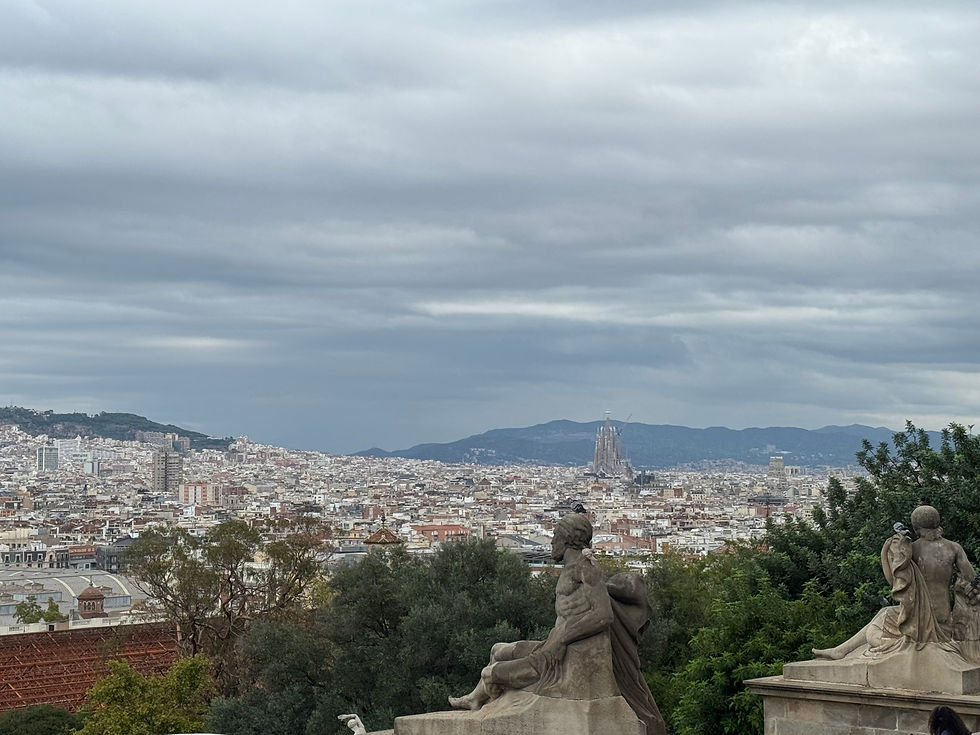
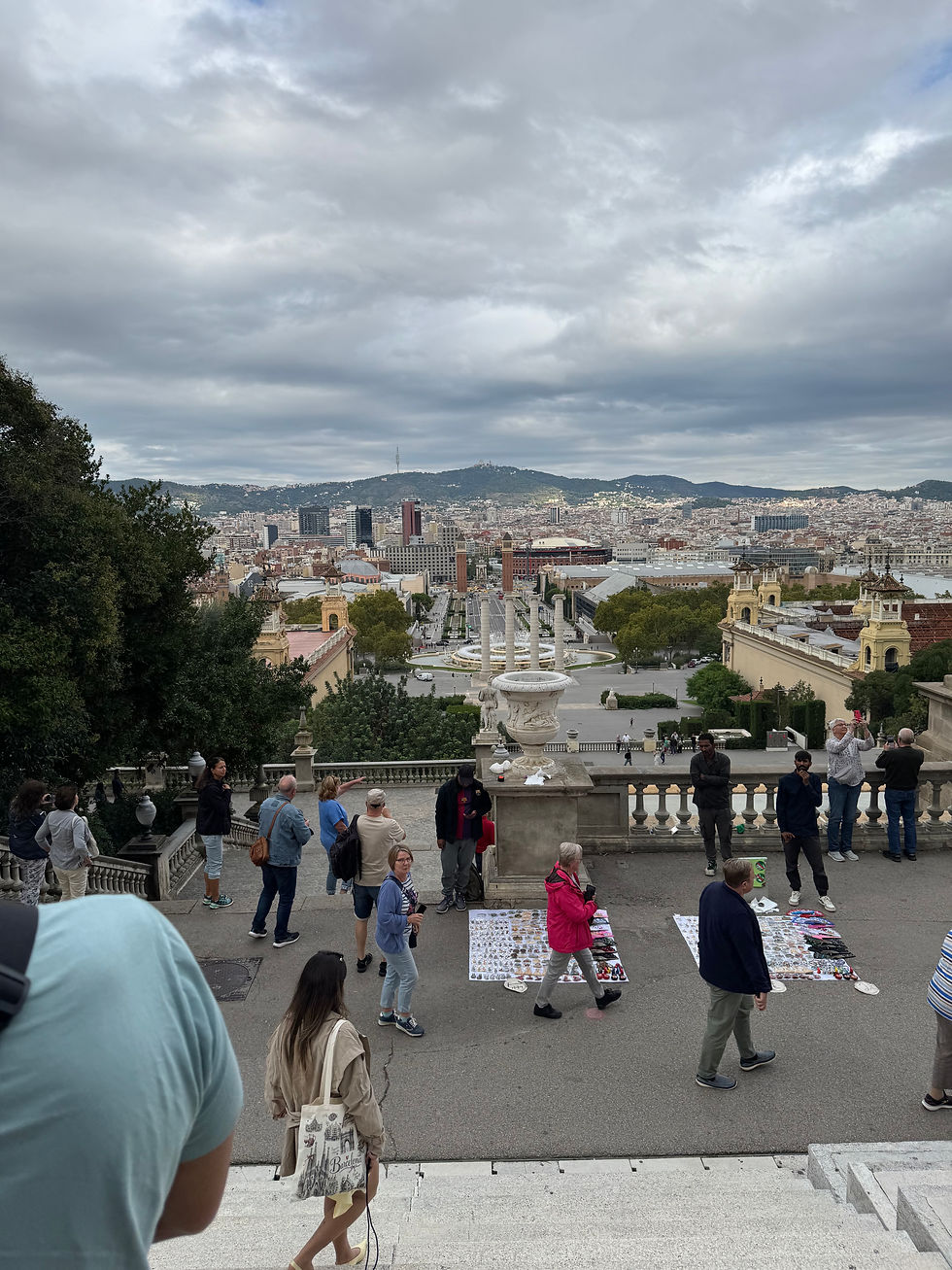
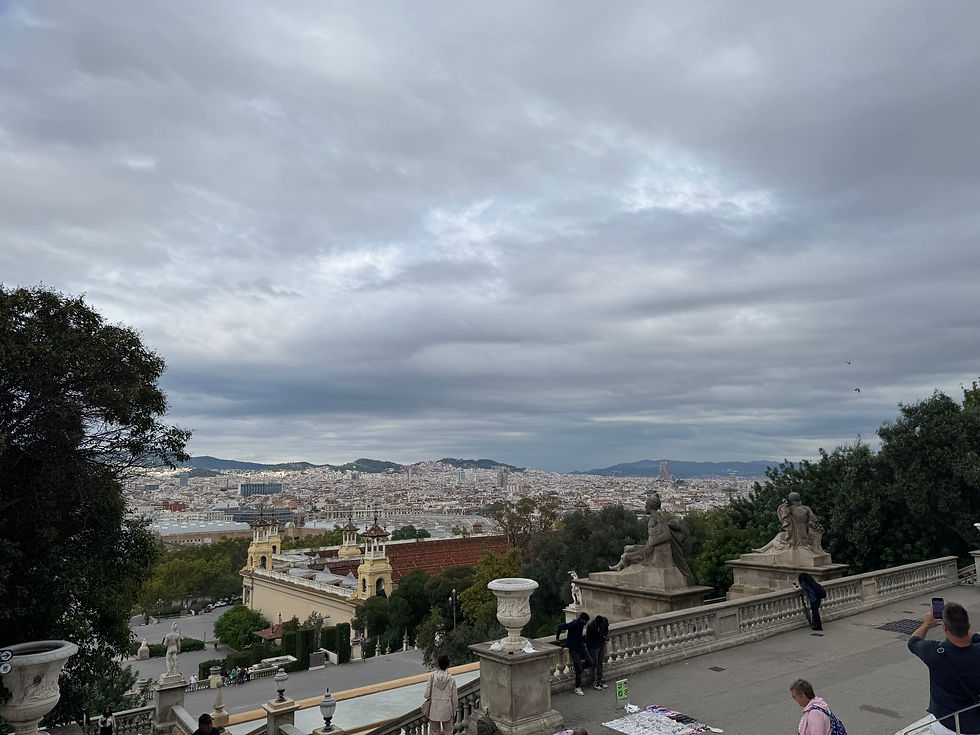
After walking the Gothic Quarter, we boarded the bus and headed up to Montjuïc or Montjuich, meaning "Jewish Mountain". It is a broad, low hill in Barcelona with a rich history. It was the birthplace of the city, and its strategic location, between the Mediterranean and the Llobregat River, has made it significant throughout history. The hill has a medieval Jewish cemetery, declared an area of Cultural Asset of National Interest in 2007. Montjuïc has been the site of various fortifications, including the Castle of Montjuïc dating back to the 17th century.
The area was also associated with political imprisonments and executions, and held significance during the Spanish Civil War. The hill was chosen as the site for the 1929 International Exposition, which led to the construction of several buildings, including the Palau Nacionaland the Estadi Olímpic. Montjuïc was also the location for several venues during the 1992 Summer Olympics, with the Olympic stadium as the centerpiece. The hill is now home to the Museu Nacional d'Art de Catalunya and various parks and gardens and can be accessed via the Funicular de Montjuïc and the Montjuïc Cable Car.
The hill offered beautiful views of the city of Barcelona. It was really quite beautiful and would have been interesting to explore on foot, but we were on a bus. We did get out at the Museu Nacional and walk around a bit. Really quite breath taking. Gaudí’s influence, and the works of many others led to Barcelona being declared the World Capital of Architecture for 2026.
After the hill we also visited the Hospital de la Santa Creu i Sant Pau (Recinte Modernista de Sant Pau). It is widely considered one of the most underrated architectural gems in the city, designed by Lluís Domènech i Montaner—the same Catalan Modernist architect behind the Palau de la Música Catalana—the complex is a masterpiece of Art Nouveau design. It was named a UNESCO World Heritage Site in 1997 for its bold layout and decorative details. Unlike typical dense hospitals, it features 30 distinct pavilions set among peaceful gardens, green spaces, and underground tunnels built to heal patients through beauty and fresh air. Absolutely worth the stop.

It had gone 13:30 by the time we got back to the hotel. We headed out almost immediately for some lunch. We walked into the Gothic Quarter just to the right of the front door of the hotel to a place recommended by our tour director, Fernando, called Gats. Gats or Cats. It is identified by the cats painted on the wall outside.

Patata Bravas

The Mediterranean Burrata Salad

The beef raviolis
We ordered patata bravas to share, only having a vague idea of what it was. It is nice to try local cuisine. Patata bravas simply means “spicy potatoes” and is a dish native to Spain. It consisted of potatoes cut into cubes, then fired in oil and served hot with a spicy “brava” sauce. Excellent.
Mary choose the Mediterranean Burrata salad with tomatoes and toasted pine nuts. My choice was the Ravioli de meloso de ternerà, aka tender veal ravioli. The ravioli weren’t in the Italian tradition in a tomato based sauce, but in a cream and basil sauce. Both were very good.
After lunch we napped. Doing 18:00 we went to the market and got some salami and cheese for dinner. We had our dinner in our room, packed, as we move on to Elciego in the morning, and called it a night.
Buenas noches y hola - Buonanotte e Ciao,
Enrico e Maria


Comments