September 14, 2026
September 14, 2026
Monday
Praha, Czech Republic
Good morning! It was eating lightly when I got up, but not very hard. It was supposed to stop about 08:00 which works well since we have a walking tour today. Our Conext tour guide, Pavel, texted to confirm our tour. I suggested we meet at the hotel, but he wanted to meet at a café near the Royal Place. Not a problem for us.
Using Rome2Rio and Google Maps, I figure out that we can take the streetcar Dlouhá Třida on Revolǔcní which is only about 400 meters from the hotel. The nice part was we get to travel for free, because we are over 65. We change once at Malostranská to the No. 22 streetcar.
All went well except we got on the No.22 going in the wrong direction. As soon as I figured that out, by following the path of the streetcar on Google Maps, we got off and crossed the street and got on the next one headed in the right direction. We got off six stops later at a stop named Pohořelec. The address of the Cosmai Café is located at Pohořelec 150/5.

Interior of Cosmai Cafe
Easy-Peasy. Just follow the street numbers. Google Maps seems to indicate it was downhill from where the streetcar let us off. We were just at one end of a fairly large square. So, we followed the Google Maps. There was some construction going on which slightly complicated the route. When we got to the other side of the square, we realized that Google Maps was making us walk all around the square, almost to the point at which we started. Ok, we need steps.
We actually got to Cosmai Café about 08:45. In good German efficiency and proclivity for being punctual fifteen minutes early is on time. Of course, we got a text from Pavel that he was going to be five minutes late. So, I sent him a selfie of myself in front of the café. He was impressed.
Today’s tour is called “Prague in a Day”. We are starting on “castle hill” across the river from our hotel. The description of the day and our actual timing didn’t quite coincide. Something seemed off from the time we first met Pavel. Just a slight twinge. But it is Context tour so it will be good.
We walked back up the hill to a small plaza at the top of the square where he began talking about the history of Bohemia and Czech Republic. Our first stop was at the Strahovský klášter (Strahov Monastery). The monastery is a premonstratensain abbey which was founded in 1143. The order was founded just twenty years earlier by Saint Norbet in an effort to introduce a strict form of canonical life. The canons of the order try not monks. They followed the Rule of St. Augustine but the had supplemental statues which made their life one of great austerity.
It was a rough start. The monastery was heavily damaged by fore in 1258. Or did ok until the Hussite Wars. The monastery was attacked and hindered in 1420. Books, articles of worship, and the furnishings of both church and convent were burned. Although the building did not sustain great damage from an architectural viewpoint, the monastery took a long time to recover.
It was not until the arrival of the abbot Jan Lohelius that a turnabout came. He became the abbot of Strahov in 1586 and he devoted all his abilities to the renewal of Strahov. He tried to raise the spiritual life of the monastery and, as a visitator circarie of the Premonstratensian order as a whole in Bohemia, he also devoted attention to the material aspect of things. He reconstructed the church, renewed the abbey buildings, established workshops, built a new dormitory and refectory, and had the monastery gardens newly laid out. He regained many of the monastery estates in order to build up the material base of the monastery, providing funds for the institution's maintenance and further development. Thanks to his untiring activity, by 1594—only eight years after his appointment—a twelve-member community of monks could live in the monastery once more.
One of the biggest events in the history of the Premonstratensian order was the transfer of the remains of Norbert of Xanten, the founder of the order, from Magdeburg. The reinterring came about in 1627, and since then the remains of the saintly founder have laid at rest in the abbey church. During
In 1670 Jeroným Hirnheim, a philosopher and theologian, became the abbot of Strahov. His greatest work, which has survived to the present day, was the building of a new library in the so-called Theological Hall (Teologický sál), completed in 1679. After 1950, the library was incorporated into the Memorial of National Literature. Following the events of 1989 the library was, along with the monastery, returned to The Premonstratensians.
The Strahov Library contains over 200,000 volumes, including over 3,000 manuscripts and 1,500 first prints stored in a special depository. It is considered one of the world's most valuable and preserved libraries, with ceilings adorned with frescoes by Siard Nosecky and Anton Maulbertech.
In addition to the Theological library is the Philosophical Hall (Filosofický sál),built for the books coming from the southern Moravian Louka Convent (abolished in 1784) most of which were non-theological tomes.
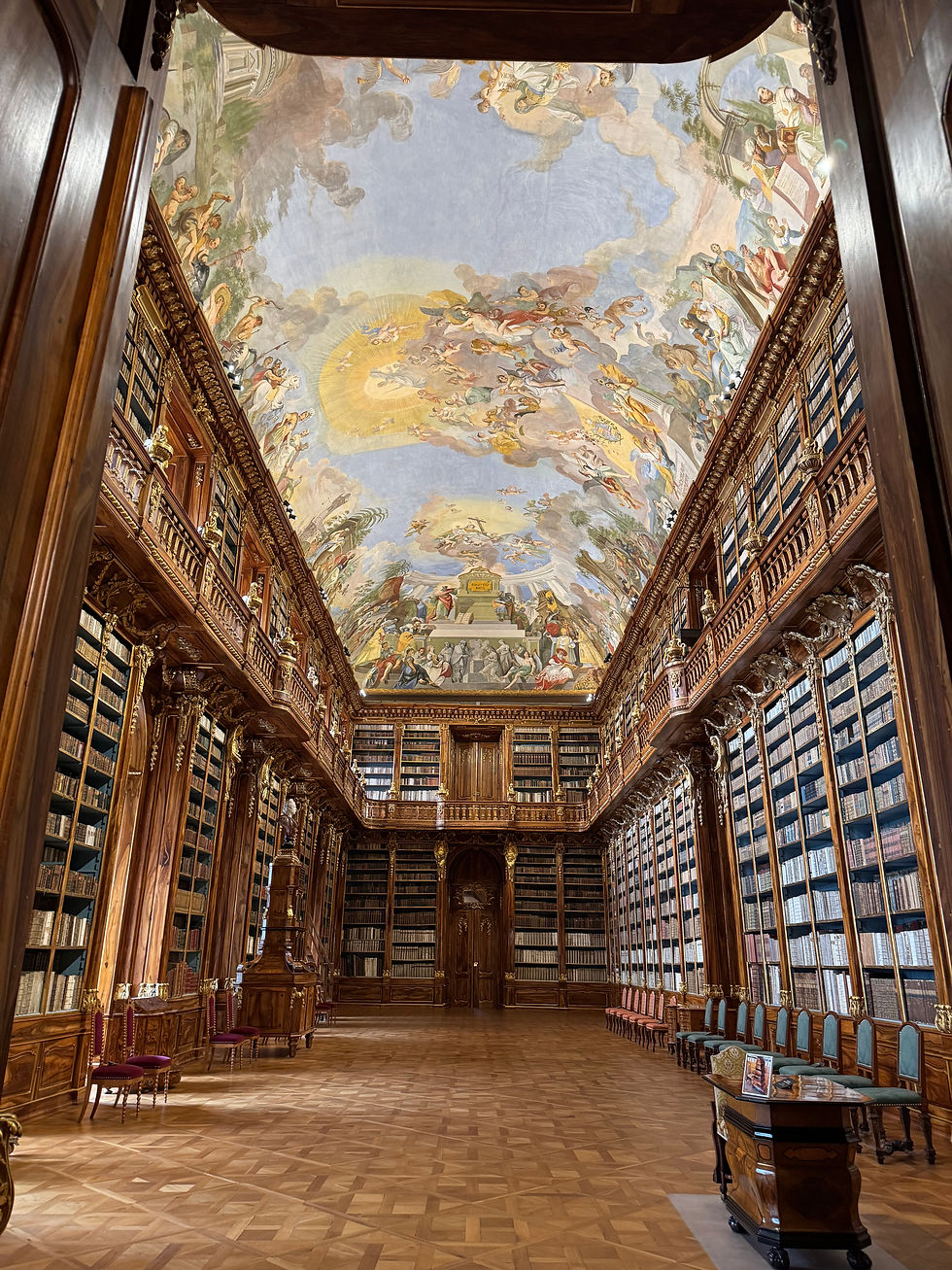
One of the libraries

The intreior of the the church at the monastery
After the fall of the communist regime in 1989, the monastery was returned to the Premonstratensian Order, which began to realize a costly reconstruction of the building. By 1994 the church had been restored, a new technical network constructed, the Strahov picture gallery newly built, and the Strahov library renewed. Other architectural restorations were also carried out.
The church and libraries are very impressive. It would be fun to be able to read some of the several century old books, but alas that isn’t a possibility. We can look but not touch. There is also an impressive and interesting collection of globes. It was somewhat fun to see how people pictured to world just 100 years ago. Makes one wonder what people 100 years from now will think of us.
We finished up at the monastery and walked down the hill to The Prague Castle (Pražský hrad). We stood in Hradčanské Square. A very large square, by the main entrance of the castle. The castle hosts of offices of the President of the Czech Republic. There were guards in fancy dress uniforms. And there were guards with more lethal guns. We walked around the front entrance to the left and entered the first court of the castle. Here Pavel bought us tickets at the entrance of the Picture gallery.
For some reason we didn’t visit the picture gallery but walked on through to the second courtyard. Here he told us that the Old Royal Place and St. Vitus Cathedral were closed because they were setting up a new exhibit of the Crown Jewels which was to begin on Friday. These are two major things to see here. A bit of a disappointment.
We sat in the third courtyard and looked at the Great South Tower of the Cathedral. It is impressive, not just the tower but the whole cathedral. The we continued into the fourth courtyard and visited St. George’s Basilica. The basilica is the oldest surviving church building within the castle and was started in 920, making it over 1,100 years old.
After the basilica we walked to the “Golden Lane”. A series of small houses built into the castle wall. Today it is nothing but a bunch of tourist shops. Historically the houses were built to house the castle’s marksmen and guards. Later it became an area where the goldsmiths plied their trade. Over the centuries, the small houses transition into homes for the poorer working class, beggars and artists. People lived here as late as 1953. There is also a claim that Franz Kafka lived and wrote in House No. 22 during 1916 and 1917, but Franz apparently moved about a lot because there are plaques everywhere in the Praha saying he lived here, stayed here, ate here, or wrote here.

The Great South Tower
It was going on to 13:00 when we stopped at the Lobkowicz Palace Restaurant and Café located, interestingly on the ground floor of the historic Lobkowicz Palace. It was all quite modern but did offer a stunning panoramic view of Praha from the terrace. We chose to sit inside out of the sun.
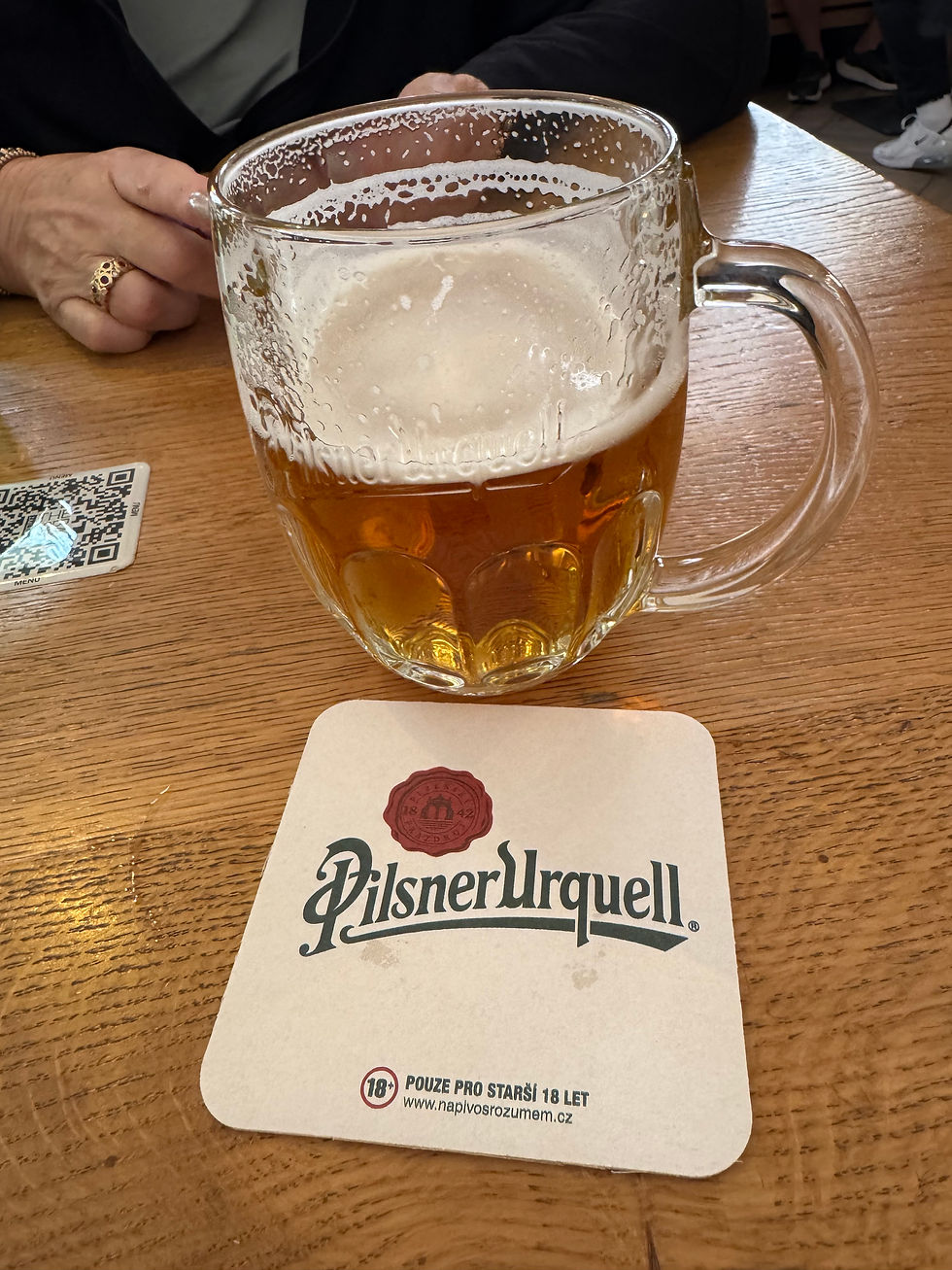
I got a beer called Bernard, which is a light pilsner. Mary got a mallinová limonata (raspberry limonade). We also got a bottle of still water. Mary had the tomato soup and I chose the Czech Goulash. Both dishes were very nice. For dessert we shared a Black Forest Cake, which was good but really too much.

My Czech Goulash

Mary’s soup and half ham sandwich

Our Black Forest Cake
After lunch we continued walking down hill to the river. Along the way Pavel pointed out various villas and convents, and even a couple churches. Then we cross the Vitava River on the Mánesův Most (Manes Bridge) and walked into the Old Jewish Ghetto. We visited the Pinkas Synagogue and Holocaust Museum. Then we walked through the old Jewish Cemetery which is in the center of town. Pavel explained that the cemetery isn’t built on a hill but the burials are stacked and dirt added on top of each successive burial. This obviously raises the ground level.
Pavel wanted to continue to tour and walk down to the St. Charles bridge, but it had gone 16:00, the scheduled time to end the tour, and we had more than 10,000 steps, and we were tired. We broke off the tour and headed back to the hotel, which was only a few blocks away.
Mary took a short nap and I went out on to the patio and had a cigar. Just before 19:00 we walked next door to the Hotel Maximilian to get something to eat. I had a glass of Drappier Champagne and Mary had a Czech Springer Merlot. Julia prepared a plate with Comte 24 month cheese, Tommy de Savole, and Jamon and Lomo Iberico ham. We topped that off with some chips.

Exterior of our hotel; we were in the center room on the 3rd (American) floor.

Hotel Maximilian Next door

Front desk and entrance of our hotel

The room where we played cards
After dinner we walked back to the hotel. Played a game of canasta, which Mary keeps winning. Then it was bed time.
Buonanotte & Ciao
Enrico and Maria


Comments