September 19, 2026
September 19, 2026
Saturday
Wien, Austria, with a side trip to Bratislava, Slovakia
It is too early for a good morning. Awaking up at 05:30 generally isn’t a problem, but staying in a hotel we can’t make coffee, and there is nothing open before 08:00 in Wien. So, I have been reading David Baldacci’s “Hope Rises”. Hopefully it can be finished before we leave. It is a hard bound book and takes up too much space and weight.
Almost done with the book. Just a few pages to go but it is time to get downstairs and meet Obada our driver for the side trip to the capital of Slovakia – Bratislava. We are going to see two castles and old town Bratislava. Hradu Devin (aka Devin Castle), Hradu Bratislava, and Bratislavské Staré Mesto (the old town of Bratislava).
It is shocking that “western” or European history just seems to ignore what is called Eastern Europe. There is a rich history on the central plains which, probably due to the fear of communism, just gets left out. There is a lot of pre-history in the area. Slavic tribes, an Indo-European ethnolinguistic group of people who speak various Slavic languages and trace their early tribal origins to Central and Eastern Europe, settled in the region is the 5th and 6th centuries.
Durng the early part of the 9th century Prince Mojmír I united the principalities of Moravia and Nitra around 830–833 AD to establish Great Moravia, a state along the Morava River. Byzantine missionaries St. Cyril and Methodius arrived in 863 and introduced Christianity and the first Slavic alphabet. This grew into the Great Moravian Empire under King Svatopluk I (ruled 870–894 AD). The Great Moravian Empire reached its greatest territorial extent, covering modern-day Czechia, Slovakia, Hungary, and parts of surrounding countries. Internal power struggles and invasions by Hungarian tribes led to the collapse of the empire around 907 AD.
From 997 to 1028 King Stephen I (aka Saint Stephen) consolidates the Christian Kingdom of Hungary, permanently tying Slovak lands to the Hungarian crown. In the 11th century the territorial organization of the region solidifies, clearly defining Upper Hungary as home to the Slovak population within the broader multi-ethnic medieval state. In the 12th century the first German settlers arrive in the northern Spiš region. They were invited for their skills in developing mining, trade, and local towns. Feudal structures deepen across the rural during the late 12th century, developing urban landscapes, and laying the groundwork for major town charters in the subsequent century.
The 13th century saw the Mongol hordes invade and devastate the territory of Slovakia, destroying villages, churches, and slaughtering or displacing a large portion of the local population. Following the withdrawal of the Mongols in the mid-13th century, King Béla IV encouraged the arrival of German settlers (Carpathian Germans) to rebuild ruined areas, revive the economy, and develop fortified towns and mining centers. King Béla IV also issued a formal charter confirming the special legal status and rights of Jewish communities living in towns like Bratislava and Pezinok. Central Slovak mining towns (such as Banská Štiavnica and Kremnica) gained prominence for gold, silver, and copper production, while regional alliances like the Community of Saxons of Spiš (Zips) were established. At the end of the 13th century minority groups were assimilated or immigrated elsewhere. Muslim communities, left over from the Ottoman Empire period, residing in the Nitra region disappeared or converted to Christianity, concluding a period of diverse local demographics under the feudal Hungarian administration.
During the 14th century, the territory of present-day Slovakia was a vibrant, highly urbanized, and economically vital part of the Kingdom of Hungary, driven by major mining wealth and diverse settlement. The death of Andrew III in 1301 ends the Árpád dynasty, leading to a period of political struggle for the Hungarian throne, during which powerful local oligarchs (such as Matthew Čák in western/northern Slovakia) temporarily control vast territories. The reign, 1308 – 1342, of King Charles I (Károly Róbert) of the Anjou dynasty restores royal authority, stabilizes the currency, and promotes the economic growth of mining towns in Slovakia. In 1328 King Charles I grants important mining privileges to Kremnica, elevating it to a royal minting town where the famous Kremnica ducats (gold coins) begin production. Around this time, Kremnica produces about 400 kg of gold annually.
Mid-14th century the Carpathian German (Zipser German) and Jewish communities expand significantly, boosting trade, urban development, and craftsmanship in towns like Levoča, Košice, Bardejov, and Prešov. The reign of King Louis I (Louis the Great, 1342 – 1382) sees continued prosperity; towns in present-day Slovakia solidify their status as economic powerhouses, contributing to a period where the Kingdom of Hungary produces roughly 25% of Europe's total gold and silver output. In 1369 King Louis I issues a royal coat of arms for the city of Košice, marking the first recorded municipal coat of arms in Europe. Cultural and educational ties with neighboring lands grow as local Slovak students increasingly begin attending the University of Prague. The reign of King Sigismund of Luxemburg begins in 1387, steering the region into new geopolitical alliances and subsequent conflicts with the advancing Ottoman Empire and internal religious movements.
King Sigismund of Luxemburg continued to rule until 1437. During which time he favored Bratislava (then Pressburg), enhancing its political and economic importance within the Kingdom of Hungary. Late in King Sigismund’s rule Czech Hussite armies launched multiple military campaigns and raids into Slovak territory, capturing towns and castles while spreading religious and social reform ideas. In 1434 and 1435, financial terms were officially negotiated for the Hussites to leave the region. By 1436, the conflict subsided as Sigismund of Luxemburg was finally accepted as the King of Bohemia, formally bringing the Czechs and Slovaks under a single ruler.
Recognizing its strategic importance during the final waves of the Hussite conflicts, King Sigismund granted Pressburg (modern-day Bratislava) the right to use its own coat of arms in 1436 and ordered major structural improvements to Bratislava Castle. King Sigismund died in December 1437. He was succeeded by his son-in-law, Albert II of Germany (Albert of Habsburg), who assumed control over the combined realms of Hungary, Bohemia, and Germany. King Albert’s reign was cut short when he died abruptly of dysentery in October 1439. His sudden death plunged the region into a severe succession crisis. To protect the royal claims of Albert's unborn son (Ladislaus the Posthumous), the Dowager Queen Elisabeth hired Czech mercenaries led by the famous captain Jan Jiskra of Brandýs. Jiskra quickly seized control of major towns in Slovakia—including Kremnica, Levoča, and Bardejov—initiating decades of internal military conflict.
The Hungarian nobility, however, chose King Władysław III of Poland (Vladislaus I of Hungary). Jiskra fortified Slovak towns, controlled the wealthy mining regions (like Banská Štiavnica and Kremnica), and successfully minted coins in the name of Ladislaus, operating independently of the central Hungarian government for over a decade. As Jiskra’s centralized control waned, disbanded mercenaries and radical Hussites formed roaming bands known as the Bratríci (Brothers). They built small fortresses (tábory) across Slovakia, living off plunder and demanding ransoms from wealthy towns and monasteries. The movement posed a massive threat to regional stability until it was decisively crushed in 1467 at the Battle of Veľké Kostoľany by the forces of the new Hungarian king, Matthias Corvinus.
The election of Matthias Corvinus stabilized the kingdom and integrated Slovakia into a powerful, centralized Renaissance state. Many of the battle-hardened Czech and Slovak mercenaries who previously fought against the crown were recruited into Corvinus’s elite standing military force, the Black Army. The mining towns in central Slovakia reached peak production of copper, silver, and gold, funding much of Corvinus's ambitious foreign military campaigns.
Despite the early conflicts, the second half of the 15th century was a period of immense cultural flowering in Slovakia. Academia Istropolitana was founded by Corvinus in 1465 in Bratislava (then Pozsony), this was the first university on the territory of modern Slovakia. It brought humanism and Renaissance science to the region, employing scholars like Johannes Regiomontanus. Slovak towns experienced a building boom. This era saw the construction and expansion of stunning Late Gothic structures, such as the St. Elisabeth Cathedral in Košice and the initial works of Master Paul of Levoča. German colonists had historically dominated Slovak mining and trading towns. In the 15th century, the ethnic Slovak population grew significantly in wealth and political power, leading to official decrees (like the Privilegium pro Slavis counterparts) ensuring Slovaks had equal representation on town councils.
Following Corvinus’s death in 1490 without a legitimate heir, the throne passed to the Jagellonian dynasty (Vladislaus II). Central royal power weakened significantly. Powerful noble families, such as the Zápolya family, began consolidating massive estates across Slovakia (including Spiš Castle and Trenčín Castle), setting the stage for the feudal exploitation and peasant unrest of the early 16th century.
On August 29, 1526, at the Battle of Mohács, the Hungarian army was crushed by Ottoman forces, and King Louis II died. This led to the partition of Hungary and the rise of the Habsburg monarchy. with Ferdinand I elected as the new ruler of the kingdom. Ferdinand I (10 March 1503 – 25 July 1564) was the King of Bohemia, Hungary and Croatia from 1526, he had been the Archduke of Austria since 1521, In 1556 he became the Holy Roman Emperor and remained so until his death in 1564.
In the 16th century Lutheran and Protestant ideas rapidly gained ground across Slovak territory, particularly in German-speaking mining towns and among local nobles. In 1536 with Buda occupied by the Ottomans, Pressburg (modern-day Bratislava) became the temporary capital, legislative center, and coronation city for Royal Hungary. In the later half of the 16th century Slovakia was transformed into a heavily militarized frontier zone against the Ottoman advance. Castles and town walls were reinforced, and local populations faced constant threat of border raids. In 1563St. Martin’s Cathedral in Bratislava began hosting the coronations of Hungarian kings and queens (starting with Maximilian I), cementing the region's political importance.
Overview
The 17th century Slovakia was defined by anti-Habsburg noble uprisings, intense religious conflicts between Protestants and the Catholic Counter-Reformation, and devastating Ottoman incursions. Stephen Bocskay led a major anti-Habsburg rebellion of Hungarian nobility between 1604 - 1609, protesting Habsburg absolutism and religious persecution of Protestants. It concluded with the Peace of Vienna, guaranteeing religious freedom for Hungary's estates. Gabriel Bethlen, Prince of Transylvania, captured Pressburg (modern Bratislava) and launched multiple anti-Habsburg campaigns into Slovak territory between 1619 and 1626.
George I Rákóczi continued the armed resistance of Hungarian-Hungarian/Transylvanian nobles against Habsburg centralization and Counter-Reformation pressure in the 1630’s and 1640’s. In the 1650’s spearheaded by figures like Cardinal Peter Pázmány and the Jesuits, systematic efforts rolled back Protestant dominance and re-established Catholicism across many towns. In the Austro-Turkish War of 1663 & 1664 Ottoman forces under Grand Vizier Köprülü Fazıl Ahmed devastated large parts of southern and central Slovakia, capturing the key fortress of Uyvar (Nové Zámky), which became an Ottoman provincial center.
The Wesselényi conspiracy of 1670 & 1671, a failed magnate plot against Emperor Leopold I, led to violent reprisals, and the suspension of the Hungarian constitution, and active persecution of Protestant ministers. Imre Thököly led a kuruc anti-Habsburg uprising, establishing a short-lived Ottoman vassal state of the Principality of Upper Hungary between 1682 and 1685, encompassing much of present-day Slovakia.
Thököly’s kuruc forces fought alongside the Ottoman army in the 1683 Battle of Vienna which was decisively defeated by an allied Christian army led by Polish King John III Sobieski, marking the turning point of Turkish power in Europe. Following the retreat of Ottoman forces, anti-Habsburg resistance was brutally crushed by imperial courts, culminating in the execution of numerous nobles and citizens in Prešov. By the close of the century, a significant portion of the population and many towns in Slovakia had embraced Protestantism, setting the stage for later Counter-Reformation conflicts.
During the 18th century, Slovakia (then part of Upper Hungary within the Habsburg Monarchy) experienced a golden age of mining, major educational reforms, and the early seeds of the Slovak national revival. During the reign of Maria Theresa, The Holy Roman Empress, Bratislava (then Pozsony) served as the capital, coronation city, and legislative center of the Kingdom of Hungary, flourishing as a cultural and economic hub. Maria Theresa established the Mining Academy in Banská Štiavnica, recognized as the world's first school of higher education in mining technology. She introduced Ratio Educationis, setting up compulsory primary school attendance and raising overall literacy rates in the region. Bratislava lost its status as the Hungarian capital inn 1784 when the central administration and royal crown jewels were moved to Buda.
Emperor Joseph II abolished serfdom across the Hungarian Empire in 1785; improving social mobility and legal rights for the rural peasantry, which included the majority of Slovaks. The late 18th century saw the Slovak National Revival begin as intellectuals, writers, and Catholic priest Anton Bernolák laid the groundwork for a distinct Slovak literary identity and established the Slovak Learned Society (Slovenské učené tovaryšstvo) in 1792, establishing the first codified version of the Slovak language based on western dialects.
The 19th century in Slovakia was a defining era of national awakening, cultural codification, and political struggle against attempted assimilation within the Kingdom of Hungary and the Austrian Empire. In 1843 Ľudovít Štúr, alongside Michal Miloslav Hodža and Jozef Miloslav Hurban, codified the modern Slovak literary language based on the central Slovak dialect. Štúr began publishing the first independent Slovak newspaper in 1845, Slovenskje národňje novini. On September 19, 1848 The first Slovak National Council (Slovenská národná rada) was established in Myjava as the political and military command during the 1848–1849 revolutionary uprisings against the Hungarian revolutionary government.
The Memorandum of the Slovak Nation (Memorandum národa slovenského) was adopted in 1861 in Turčiansky Svätý Martin, outlining demands for Slovak political autonomy, schools, and cultural self-determination within Hungary. Matica slovenská was founded in 1863 in Martin as the premier cultural, scientific, and educational institution for the Slovak nation. The Austro-Hungarian Compromise of 1867 created the dual monarchy, placing the territory of Slovakia firmly under direct administrative control of the Hungarian government in Budapest. The Hungarian government abolished Matica slovenská in 1875 and began an intense campaign of Magyarization (forced assimilation), closing Slovak-language high schools and restricting non-Hungarian cultural life.
Between 1884 and 1901 the Slovak National Party adopted a policy of electoral abstention to protest political oppression and gerrymandering by the Budapest administration. Like much of the rest of Europe the late 19th century was on of economic hardship and cultural oppression which prompted a mass wave of emigration, with tens of thousands of Slovaks leaving for the United States (particularly industrial centers in Pennsylvania).
1907 saw the Černová Tragedy where Hungarian gendarmes shot and killed 15 Slovak villagers protesting the consecration of a church by a pro-Hungarian Slovak priest, turning the event into a symbol of national oppression under Hungarian rule. In 1914 at the outbreak of World War I Slovak soldiers were mobilized into the Austro-Hungarian army; many later deserted or defected to fight against the empire on the Russian and Italian fronts. During the World War exiled leaders like Tomáš Garrigue Masaryk, Milan Rastislav Štefánik, and Edvard Beneš began actively campaigning in Western capitals for a joint independent state of Czechs and Slovaks.
Slovak and Czech émigré organizations in the United States signed the Cleveland and Pittsburgh agreements outlining the political framework for a future common democratic republic that would grant Slovakia administrative autonomy in May 1918. The independent republic of Czechoslovakia was officially proclaimed in Prague on October 28, 1918, following the collapse of the Austro-Hungarian Empire. The Martin Declaration (Declaration of the Slovak Nation) was adopted in November 1918, in which Slovak representatives formally adhered to the new Czechoslovak state and separated themselves politically from Hungary. In 1919 Czechoslovak military forces secured the territory of Slovakia against the invading Hungarian Soviet Republic, establishing provisional borders.
The Czechoslovak Constitution is adopted on February 29, 1920. It establishes a parliamentary democracy and officially creates the concept of a singular "Czechoslovak nation". This irritates Slovak nationalists who view it as a way to dilute distinct Slovak identity. At the Treaty of Trianon on June 4, 1920 the definitive southern border between Slovakia and Hungary was internationally confirmed and formalized. In August 1920 Czechoslovakia forms the Little Entente alliance with Yugoslavia and Romania to deter Hungarian attempts at reclaiming territorial losses.
By 1921 Slovakia makes significant strides, officially becoming the tenth country in the world to produce feature-length films. The government reorganizes administrative borders in 1923, replacing older Hungarian counties with six grand counties (župy) in Slovak territory. The state transitions to a four-land administrative system in 1928, officially designating "Slovakia" as one of the four corporate provincial lands alongside Bohemia, Moravia-Silesia, and Sub-Carpathian Ruthenia. Then the global Great Depression, 1929 - 1933 hits Czechoslovakia hard. Slovakia, heavily reliant on agriculture and developing industries, suffers deep economic stagnation, fueling the popularity of the pro-autonomy Slovak People's Party led by Andrej Hlinka.
The rise of Nazi Germany destabilizes the democratic republic, leading to its dismemberment. September 1938 The Munich Agreement is signed by Germany, the UK, France, and Italy. Czechoslovakia is forced to cede its Sudetenland border regions to Germany. President Beneš resigns shortly after. In October of the same year, capitalizing on Prague’s weakness, Slovak political parties sign the Žilina Agreement, declaring Slovak autonomy within a newly federalized "Czecho-Slovakia". Catholic priest Jozef Tisobecomes the Prime Minister of the autonomous Slovak government.
The First Vienna Award forces the autonomous Slovak region to cede large parts of southern and eastern Slovakia (including towns like Košice) to Hungary in November 1938. Hitler uses Slovak separatism as a crowbar to completely fracture what remains of the Czechoslovak state. In March 1939 fearing total separation, the Prague central government deploys troops to Slovakia and deposes Jozef Tiso, an action known as the Homolov puč. Adolf Hitler summons Jozef Tiso to Berlin on March 13, 1939, giving him an ultimatum: declare absolute Slovak independence immediately, or let Hungary annex the remaining Slovak lands. The next day the Slovak diet meets in Bratislava and votes to declare the independent Slovak Republic (commonly known as the First Slovak Republic or the Slovak State). Jozef Tiso assumes power.
The following day, March 15, 1939, German troops occupy the Czech lands, turning them into the Protectorate of Bohemia and Moravia. Czechoslovakia ceases to exist. A week later Tiso signs the Protection Treaty (Schutzvertrag) with Nazi Germany, legally binding Slovakia's foreign policy, military, and economy to German commands. On September 1, 1939, Slovakia participates alongside Germany in the invasion of Poland, marking its official entry into World War II as an Axis-aligned country. The Slovak State implements authoritative, fascist domestic systems, creating the Hlinka Guard paramilitary and systematically introducing severe anti-Jewish civil restrictions.
In August 1944 there was the Slovak National Uprising (SNP) centered in Banská Bystrica, Slovak soldiers, democratic resistance groups, and communist partisans launched a massive armed revolt to overthrow the collaborationist Tiso government. The Wehrmacht brutally suppressed the uprising. Germany formally occupied Slovak territory, resulting in devastating reprisals, the burning of villages, and renewed deportations. On April 4, 1945, the Soviet Red Army liberated Bratislava, effectively dissolving the wartime Slovak Republic. After World War II ended in Europe, and Slovakia was reintegrated into the Third Czechoslovak Republic. Territories previously annexed by Hungary were returned, though the eastern region of Subcarpathian Ruthenia was ceded to the Soviet Union.
A 1948 coup brought a totalitarian Communist regime backed by the Soviet Union to Czechoslovakia. The brief political reforms led by Alexander Dubček, called the Prague Spring (1968) were crushed by a Warsaw Pact invasion. Mass peaceful protests ended Communist rule in 1989, often called the Velvet Revolution. 1993 saw the Velvet Divorce where Czech and Slovak leaders agreed to a peaceful division of the Czechoslovakia. On January 1, 1993, Slovakia became an independent, modern democratic nation. Slovakia joined NATO and the European Union in 2004, entered the Schengen Area in 2007, and adopted the Euro in 2009. Today, it is a high-income, developed market economy and a global leader in per-capita automotive manufacturing.
Ok, maybe I digressed a little too much. But, hey now we both know more about Slovakia’s somewhat touchered history.
Obada arrived in a late model Tesla Model Y right on time 09:00. We met him at the corner of Liliengasse and Weihburggasse just a few meters from the front of the hotel. In theory, the street directly in front of the hotel is a pedestrian only zone. You can turn off of Liliengassee on to Weiburggasse however there is maybe a car length or two before it becomes pedestrian only. However, because there is construction in that short space, it is difficult to enter.
The next hour was spent following the Danube east towards Bratislava or more accurately Devin. Once we got out of the city it was mostly farmland. There was one very large petrochemical plant and the airport. We crossed the Danube and drove into Devin. We arrive at Műzeum mesta Bratislava-Hrad Devin just about 10:00. Obada let us out at the entrance to castle.

The braille map and outline of Devin Castle

Looking up at the castle from a spot on the trail near the entrance.

Evidence that Mary made it to the top, ok me too as I took the photo.

Evidence I made it as well.

Some of the steps to get to the top
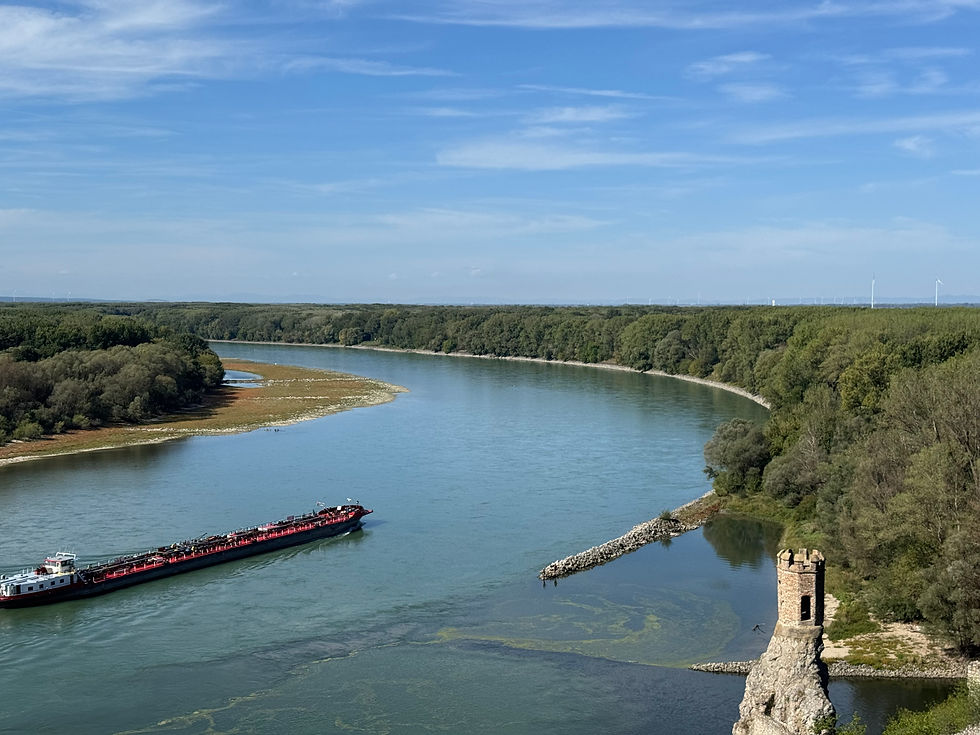
View of the Danube fron the top.
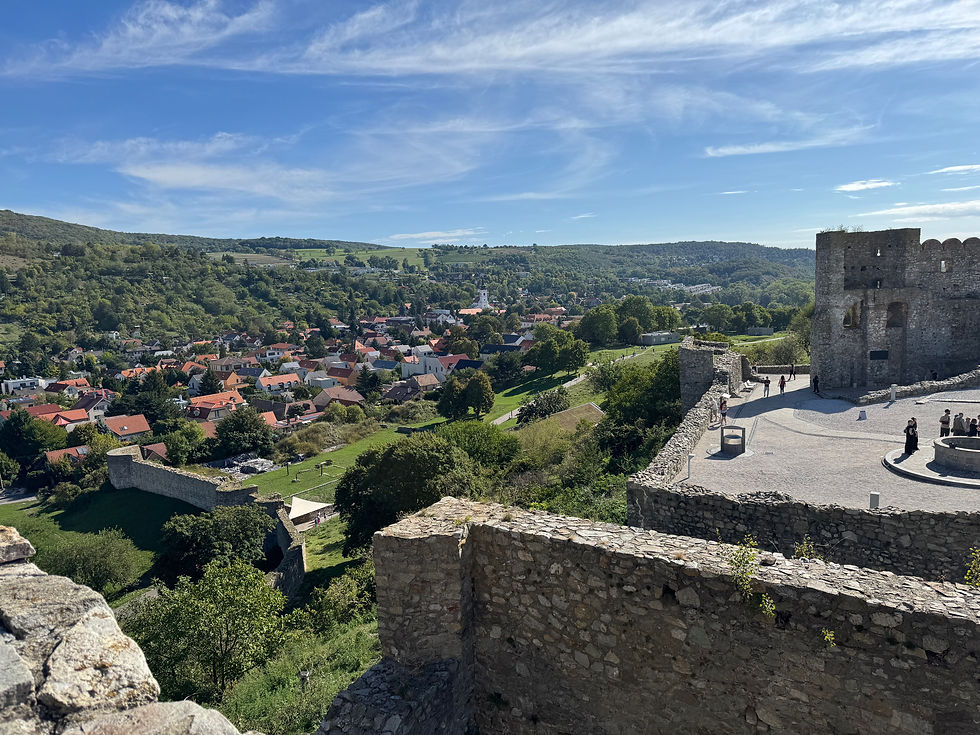
View looking away from the Danube towards the town of Devin.

The castle part way up to the top.
General admission is €8.00 per person. However, seniors at only €4.00 per person. What is left to see here are the ruins of a medieval castle. The castle itself rests on the peak of the rock outcropping high above where the smaller Morava River meets the Danube River.
People have lived in the area for thousands of years. There is evidence of the Roman Empire fron the third to fourth centuries. Archaeologists made the discover of what is believe to be the oldest bread in Slovakia. It is a carbonized loaf of fermented dough and was probably produced in the fifth century period of so-called migration of peoples.
As you read above in the 13th century Devin was a Hungarian royal castle. At the same time, it was also a border fortress. You could even call this general area a four corners area because the four countries meet here – Austria, Czech, Hungary and Slovakia. We walked and climbed all the way up to the upper castle. We did have to stop and rest a few times. It wasn’t that hot out, but it was quite a hike. It took a good forty-five minutes to climb to the top.
It took substantially less time to get back down. We met Obada in the parking lot just as it had gone 11:00. He then drove us into city of Bratislava and to Hrad Bratislava. From the entrance to the castle/palace the palace doesn’t look anything like a castle. It looks more like a 19th century palace. We walk up the hill, again, to get to the ticket office. The views from here overlooking the city and the Danube are really worth the hike.
There were two surprises here. One, the number of tourists. Not just Slovakians but English, French, maybe Austrian and German. I even heard one couple speaking Italian. There were actually bus loads and guides with flags on polls leading the way. We certainly have never thought of Slovakia as a tourist destination. Honestly, we didn’t even know Bratislava was such a major city.
The second, and more welcome surprise was that people over 70 years of age get free admission. Technically this is not considered Bratislava Hrad (Castle). Technically this is the Slovenské národné múzeum (Slovak National Museum). The truth is that this edifice is a reconstruction of the castle. The original burned down in a devastating fire in 1811. It the sat in ruins for the next hundred and dirty years. This reconstruction was only finished in 1968.

Bratislava Castle fromthe front

Looking up towards the Bratislava Castle from the barracks just below it.

The view out towards Bratislava from the Bratislava Castle.
Honestly, besides the views of the city from this hilltop perch there isn’t much here. The “treasury” consists of silver household articles mostly from the 19th century. In the central courtyard they had medieval “booths” set up, in the sprit of a medieval market day. Great for the little kids.
We finished here just about 12:00. Obada then drove us down the hill to the “old Town” section of Bratislava. Well, it was time for lunch as well as time for sit down and rest. This appears to be a typical “old town” or touristy area. Streets just large enough to walk on, and every other shop a souvenir shop or a restaurant. We chose one called Aplend. Looking at the menu and the seating, one is going to guess that it is some sort of chain restaurant.

Logo of the restaurant.
We ordered Bryndzové halušky domáca slancia pažika, Bačová panyička and Chrumkavé Slivkono-makové pirorky for dessert. Mary also got Jahdová limonáda pomaranč mäta. In case you don’t read Slovakian – the first one is – traditional Slovak potato gnocchi, bryndza sheep’s cheese with homemade bacon and chives. The second one is is called shepherd’s pie. It is a dish of chicken, pork, homemade sausages, bacon, roasted potatoes and bryndza sheep’s cheese. The dessert is a crispy pierogi stuffed with plum jam and poppy seeds served with a dried cranberry sour cream. Mary’s drink was a strawberry lemonade with orange and mint. Everything was excellent.

Bryndzové halušky domáca slancia pažika

Bačová panyička

Chrumkavé Slivkono-makové pirorky
After lunch we walked around old town a bit. Mostly touristy shops and restaurants. Quaint store fronts. A couple nice looking churches. After about an hour we were done and called Obada to come get us.
We then spent the next hour heading back to the hotel. We got back to the hotel just after it has gone 15:00. About 17:00 we went out for a walk. Mary got an ice cream from a cart in front of St. Stephen’s Catherdal, pistazie flavor (pistachio) if you were wondering. My choice was one of the iconic street-side sausage stands in Vienna—known as Würstelstände (recognized as UNESCO intangible cultural heritage).
The question on my mind was which of one the several varieties of traditional Austrian and Viennese sausages should I get. My previous choice was the Käsekrainer (a thick, coarse pork sausage stuffed with small cubes of Emmental cheese that melt and ooze when grilled. Understandably the most popular choice at Viennese stands.) Or, should I go for the classic, slender, lightly smoked pork-and-beef sausage which has been boiled in water or broth? That is how they describe a Frankurther or Wiener.

Too many choices
There is also the Waldviertler (a robust, heavily smoked, and coarsely ground pork sausage with a tight casing that snaps when you bite into it), the Burenwurst (a hearty, traditional boiled-or-grilled beef and pork sausage that contains no visible chunks of fat or cheese, known for its rich, rustic flavor), the Debreziner (a spicy, paprika-spiced pork sausage with a reddish hue and a noticeable kick of garlic and heat) or the simple Bratwurst (A lighter, grilled pork or veal sausage).
Because of my newly discovered problem in eating wheat, skipping Im Rohgabel (the sausage served tucked inside a hollowed-out white bread roll (semmel), getting it served Mit Brot (served sliced on a paper plate with a sharp mustard (Süsser or Scharfer Senf), and/or freshly grated horseradish (Kren). I will have to ask them not to add the usual sliced dark rye/sourdough bread they usually serve with it. Too many choices – so I went with the Käsekrainer I have had before.
After “dinner” we walked back to the hotel. We played cards. I worked on the blog. Obviously since you now know the entire history of Slovakia. Sorry I was just so fascinated by my lack of knowledge. Now I can get a good night's rest.
Buonanotte & Ciao
Enrico and Maria


Comments