November 29, 2025
- hfalk3
- Dec 1, 2025
- 7 min read
Santiago, Chile
Good morning. It is now Saturday morning and we have arrived in Santiago Chile. Country number seventy-six for me, and sixty-nine for Mary. Made it through immigration with no issues. The bags took a little while, and we were beginning to wonder of one had gotten lost. Thankfully, it showed up. We headed out the door past the drug sniffing dogs.
Oops, Richard got stopped! Turns out he had a banana he picked up in the United lounge in Houston. They seemed to forgive him and let in advance though the barrier once they had confiscated the banana. Just outside the exit was a representative from Seven Seas to greet us. The four of us and another couple were escorted to the a waiting van, which then took us to the Mandarin Oriental Hotel in downtown Santiago about a half hour away.
There is a lot of traffic in Santiago even on a Saturday morning. Apparently it had a lot to do with Black Friday sales at the Parque Arauco Mall which is next to the hotel. We got to the hotel just before it had gone 11:00. The ride in was kind-of like riding through downtown Los Angeles. The sky is hazy, not 1960’s LS hazy, more like mid-70’s hazy. The young man who met us told us that Santiago has ten million inhabitants: about fifty percent of the country's total population.
The check-in was a little backed up, so it took about a half hour to get checked-in. Our room was ready, but Richard and Susan’s room wasn’t, so we simply all headed for our room to wait for their’s to be ready. We all vegged out and even actually took about an hour's nap.
Richard went down about 12:30 and found out their room still wasn’t ready. Check-in in 14:00 anyway. However, the desk said they would call our room when it was ready. We got the call about 13:00, and Susan and Richard took their luggage down to their room.
We met in the lobby at 13:30. Maria, Susan’s friend, is going to take us to a restaurant at the Casa Costanera Mall in the Lo Castillo neighborhood, Miraolas. It is only about 2 km (1.3 miles) from the hotel if you are walking, but it is longer of you are driving, apparently due to one-way streets, and traffic. Maria is an aggressive driver, but everyone in Santiago seems to be, at least those out and about today.
The parking garage in the mall has the lights above available stalls like we have seem in Italy. It is a very efficient was to get people parked quickly. It also keeps tabs on the number of available spaces in real time. Another big help. It doesn’t take long for her to find an open stall.
The mall is just a decade old. It is very modern. It also has all the stores you would expect in any American Mall, or for that matter of fact, any mall in the world. H&M, Starbucks, Patagonia, Florsheim shoes, Brooks Brothers, and others. There was a few whose names were unknown, but not many.
There are five levels of shops. The roof is where all the restaurants are six different restaurants. Two of which were Italian, two of which were Japanese, and the last two were “local” restaurants serving fish. Miracolas was one of those. Maria said that they served typical Chilean dishes.
The first round of dishes was: Machas A la Parmesana, Calamar A Romana, Kokotxas, and lastly Papas Fritas. Apparently, there was some dispute between Maria and the waiter. Some of the things she wanted to order weren’t available, so she had to substitute for things which re go but not so much Chilean.

However, in good Falk tradition the whole meal had to start with an alcoholic beverage. Maria wanted us to try a cocktail called a pisco sour. She was very conflicted as to which was the best one. The Peruvian or the Chilean version. There is some friendly rivalry between the two countries as to who makes the best pisco.
Pisco is a colorless or yellowish-to-amber-colored alcohol produced by both the winemaking regions of Chile and Peru. It is made by distilling fermented grape juice into a high-proof spirit. You should be relating this to grappa. We can thank the Spanish settlers who developed it in the 16th century. They make pisco as an alternative to orujo, a pomace brandy that was being imported from Spain. The advantage here was that it was being produced from domestically grown grapes.
The term domestically grown grapes my be as misnomer. The grapes actually were brought from Europe, mostly Italy. Establishing vineyards in the “new world” was difficult and few if any grape varietals did well here. They did better in Peru than Chile. It all gets back to taxes and import duties. Wine produced here didn’t benefit the Spanish Crown by giving them taxes. So, they tried to limit the production of alcohol.
Of course this failed. When the taxes got too high in Peru, they started making it in Chile. As early as 1835 newspaper accounts talk about an inferior pisco being made in Chile. The original pisco, the one from Peru, is the better of the two, but we are in Chile so we won’t mention that here.
The drink being offered today is the pisco sour. Apparently, it is of Peruvian origin but is still considered traditional to Peruvian and Chilean cuisine. The base as the name implies is the brandy liquor pisco. The term sour referees to four citrus juice and sweetener components. The Peruvian pisco sour uses Peruvian pisco and adds freshly squeezed lime juice, simple syrup, nice, egg white, and Angostura bitters. The Chilean version is similar, but uses Chilean pisco and pica lime, and excludes the bitters and egg white. Like with most alcoholic beverages there are a number of variants with different fruits or plants. I only took a small sip but found it quite delightful.
Machas A la Parmesana. Chile is famous for the Macha clam, a saltwater razor clam (Mesodesma donacium) that is native to the region. It is often referred as a “Tasa” clam. They have an elongated shell, typically measuring between seven and twenty centimeters (2.75 to 7.9 inches). They range in color from brown in the very young to yellow in mature ones. Machas are known for the delicate, sweet, and oceaniche flavor with a meaty texture.
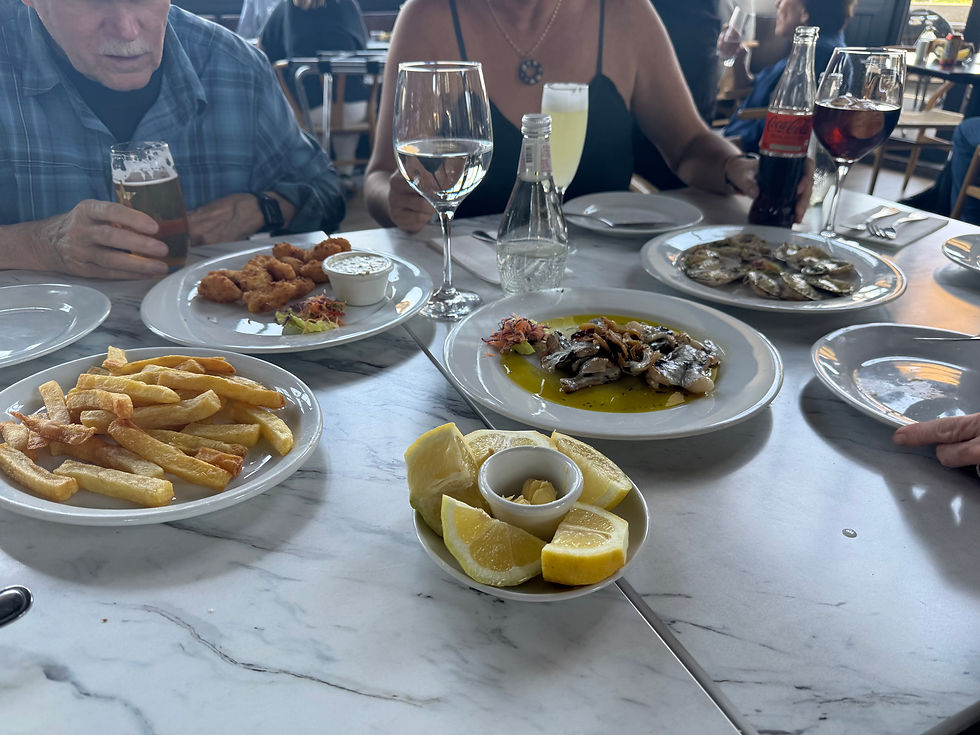
The machas as very different in appearance from the quahogs or soft-shell steamers of New England. Preparation of machas a la parmesana starts with the cleaned razor clams which are then nestled back into the shells. They are done so with a touch of butter or cream and then sprinkled generously with Parmesan cheese. These are then placed under high heat, allowing the cheese to melt and form a slightly crisp crust on top.
This particular version had a very good taste, but the cheese seemed to overpower the clams a bit. And although they were very good, it is unlikely that the cheese was Parmesan, although that is what it said on the menu. It just didn’t have the “tang” that Parmesan usually has.
Calamar A Romana simply translates to Roman-style squid, or as we more commonly like to call it calamari. In either case is it a dish of squid bodies, not including the tentacles, which are coated in a light, airy batter and deep-fried until a golden brown and crispy. It is apparently a very common tapa (appetizer) in Chile and served with tarter sauce, although fresh squeezed lemon juice did them better justice. There were very good as well.
Kokotzas is Basque dish. It is considered Chilean here, but the origins are Basque. Kokotzas is a term used to describe the gelatinous throats of the hake or cod fish. It is cut from right under the gills of the fish. It was the cheap cut eaten by the poor. Much like polenta was a dish for the poor until a few years, Kokotzas is now considered a delicacy. These fish throats were cooked in butter and toasted garlic. Nothing cooked in butter and garlic can possibly be bad. They were actually quite nice and not at all fishy. Yes, I ate fish. A part of the fish which does not have bones.
The Papas Fritas, French fries, were good. Although, as Americans, we are used to a little more salt on our French fries.

The second round of dishes was: Gabardinas, potato chips, a white fish with ham, squid rings, and shrimp, and a deep-fried fish with tartar sauce. The last two I didn’t catch the Spanish version or name for them. I got stuck on Gabardinas, which means trench coast. However, in this case it refers to shrimp in a light batter and deep-fried serves with tarter sauce. Again, the tartar sauce is overwhelming and not necessary. The shrimp were very good and tasted a lot like what you would expect to get in a Chinese restaurant in California.

The white fish was interesting. It was very light and had almost no taste beyond the ham it was served with. The presentation was very nice, but it is unclear what the ham, deep-fried squid rings and small sautéed shrimp were there for. Yes, again I tried it. Yes it probably had bones, but one can’t live forever.
The deep-fried fish was interesting. A-kin to fish and chips, although these were tablespoon sized pieces of fish which had been individually battered and deep-fried. They were also served with tartar sauce. This tartar sauce used a dill pickle rather than a sweet pickle, so it had a slightly different taste, than the stuff at home.

Opps, forgot about the crab claws. Very good and a great cocktail sauce.
Afterwards we walked around the top floor of the mall taking in the skyline of the city. Then we headed back to the hotel for a well-deserved rest period. After resting and showering we went downstairs and met with Richard and Susan. They and Mary each had something “light” for dinner. I skipped the whole thing as I was still very full for lunch.
21:00 lights out for the night. It was an interesting and fun day. Santiago looks like a nice city. Maybe a little smoggy, maybe too many people, but nice anyway.
Buonanotte e ciao,
Enrico e Maria
Comments