October 13, 2026
October 13, 2026
Tuesday
San Sebastián-Donistā, Gulpuscoa, España
With a side trip to France and Saint-Jean-De-Luz
Slept well but it ended just about 04:00. Took a nice hot bath climbed back into bed and slept until 05:30. Got up to check emails etc. and found the internet wasn’t working. At 06:00 headed downstairs to reception to find out why. They gave me a new access code, and I managed to get connected. Went back to the room and waited until 07:00 to wake Mary up. We went down to breakfast at 07:30.
It was 09:00 and we were on the road to France. Our first stop is a photo opportunity near the Phare de Biàrritz (Biàrritz Lighthouse) about 31 kilometers (22 miles) from our hotel. The Phare de Biàrritz was erected in 1834, standing 73 meters above sea level and boasting 248 steps, it overlooks Le cap Hainsart (Cape Hainsart). It was one of the first French lighthouses to be outfitted with revolutionary Fresnel lenses. Interestingly, the lighthouse had 1831 painted on the side. The internet says 1834. Which, if either, is accurate?

Biàrritz Lighthouse

Lattidtude and Longitude Marker at the lighthouse which is also a sundial
Situated on the Atlantic coast, it is famous for marking the geographic boundary between the sandy coast of the Landes and the rugged, rocky coastline of the Basque Country. Cape Hainsart was named for the oaks that once surrounded it, which have since been replaced by tamarisk trees.
Biàrritz is a city on the Bay of Biscay, on the Atlantic coast in the Pyrénées-Atlantiques department in the French Basque Country in southwestern France. It is a luxurious seaside tourist destination known for the Hôtel du Palais (originally built for the Empress Eugénie c. 1855), its seafront casinos, and its surfing culture.
It has a beautiful beach. The guide says this was the French Riviera before the French Riviera (Côte d’Azur) was popular. After the French Revolution bathing in the sea was no longer just a cure of the mentally ill. Sea bathing becomes fashionable. In 1808, Napoleon himself broke with tradition and bathed in the coastal waters here.

Looking back at the town from the lighthouse
As early was 1840 the municipality of Biarritz started a campaign to attract tourists to the seaside. In 1843, in his book the “Alpes et Pyrénées”, Victor Hugo wrote “I have not met in the world any place more pleasant and perfect than Biarritz”. So, maybe it was a decade or two or three before Nice and Cannes took over. The point is that it was a seaside resort. It was probably earlier because the train from Paris got here first? Anyway, we stopped, looked, took photos and got back on the bus and headed to Saint-Jean-de-Luz.
Saint-Jean-de-Luz is located on the Atlantic coast of France, just a few kilometres closer to Spain than Biarritz. Its wealth stems from its port and its past, with the town being associated with both fishing, and with the capture of vessels by its own Basque Corsaires, or pirates (English sailors used to call Saint-Jean-de-Luz the "Viper's Nest"). This prosperity reached its height during the 17th Century, which is still considered as the town's "Golden Age." During this period, Saint-Jean-De-Luz became the second largest town in the Labourd region with a population or around 12,000, just behind Bayonne.
Saint-Jean-de-Luz is known for its royal wedding connection. In 1659, Cardinal Mazarin spent several months in Saint-Jean-de-Luz, from where he would embark on almost daily trips to Pheasant Island in the river Bidassoa (near modern-day Hendaye) for Franco-Spanish meetings that resulted in the Treaty of the Pyrenees, one clause of which was the marriage of Louis XIV to Maria Theresa, the Infanta of Spain. Saint-Jean-de-Luz and its church were chosen to host the royal wedding on 9 June 1660. The marriage is one of the most important political marriages in history that brought an end to a bitter war.
Today, visitors of the cathedral can see that the main door is bricked off. Two legends circulate this oddity: First, it has been said that the door the couple passed through was later closed to represent the closing of the troubles between France and Spain. A more popular theory among the locals is that the king, Louis XIV, ordered the door to be closed off, so no other couple could walk into the church to be married in his footsteps.

The Alter in the church

The organ in the back of the church

Beautiful carved wood pulpit
The Duke of Wellington set up his winter headquarters in the town during the Peninsular, 1813–14. At the end of the nineteenth century, Saint-Jean-de-Luz became a popular beachside resort town for the surrounding high-society. Like Biarritz (called "The queen of the beaches, the beach of kings"), Saint-Jean-de-Luz was particularly appreciated by the French and Spanish aristocracy. By the early 1900s, it turned into the scene of Carlist conspiratorial activities. The composer Maurice Ravel, a native of the nearby town of Ciboure, frequently vacationed at Saint-Jean-de-Luz from Paris, where he was centered for almost his entire life.
The guide made the observation that Biarritz and Saint-Jean-de-Luz represented old money, while the French Riviera represented new money. Both Biarritz and Saint-Jean-de-Luz just seem like your standard seaside town. Perhaps a little fancier than say, Santa Cruz in California but the same. All the houses show the wear and tear of being by the sea. Both of them are mainly hotels, restaurants, and tourist shops. The surfing is apparently good not only there but here in San Sebastián.
The guide made some reference to long board surfing. The internet suggests that surfing didn’t get to the French seaside resorts until the 1950’s. It also suggested that long board surfing comes from Hawaii or Polynesia. I am going with the internet on this one.
Following Marshal Pétain's call for an armistice on the outset of World War II, a coastal fringe of the Basque Country fell in the German occupation area. Before the agreement was enforced, a retreating Polish Army was evacuated from the town in mid June 1940.
After 1945, some of the traditional fishing-based industries of the Fargeot district gradually disappeared, mainly by overfishing and competition from elsewhere. The change strengthened the transformation of the town towards more luxury and tourism industries. In Saint-Jean-de-Luz over 40% of dwellings of the town are second homes.
In the 1960s, the town expanded northwards (Avenue de l'Ocean) and also southwards in the direction of (the Urdazuri district). Since the 1970s, St Jean de Luz has been connected to Bordeaux to the north and Spain to the south by the motorway. St-Jean-de-Luz boasts extensive and attractive land and scenery, as well as a well-preserved coastline which has so far escaped urbanization. Although some of the Basque coast has seen a degree of development, the area between Fort Socoa and the Abbadia nature reserve and castle remains in its natural state.
My observation stands. This is a seaside resort town. It could be Eureka if the weather were worse, and the temperature a little colder. The buildings all have the same weathered look about them.
We stopped and had lunch. Looked at the church. Walked the main tourist shopping street. Everything closed at 13:00 and wouldn’t reopen until 14:30, so there wasn’t much time for both getting lunch and shopping. We chose lunch.
The guide took us to Place Louis XIV a small square near the harbor. There we sat down at La Marine – Bar Brasserie, one of the places they suggested we eat at. About a third of the group also chose this place for lunch. Mary and Mike had the first of the Day which was a shrimp risotto. I Choose the l’espagnole (Lomo, sauce basquaise, Serrano, brebis, pommea de terra sautées, salade, aka pork loin, Basque-style sauce, Serrano ham, sheep's milk cheese, sautéed potatoes, salad). I wasn’t all that great, but not all that bad either.

Mary’s fish of the day - scary right?
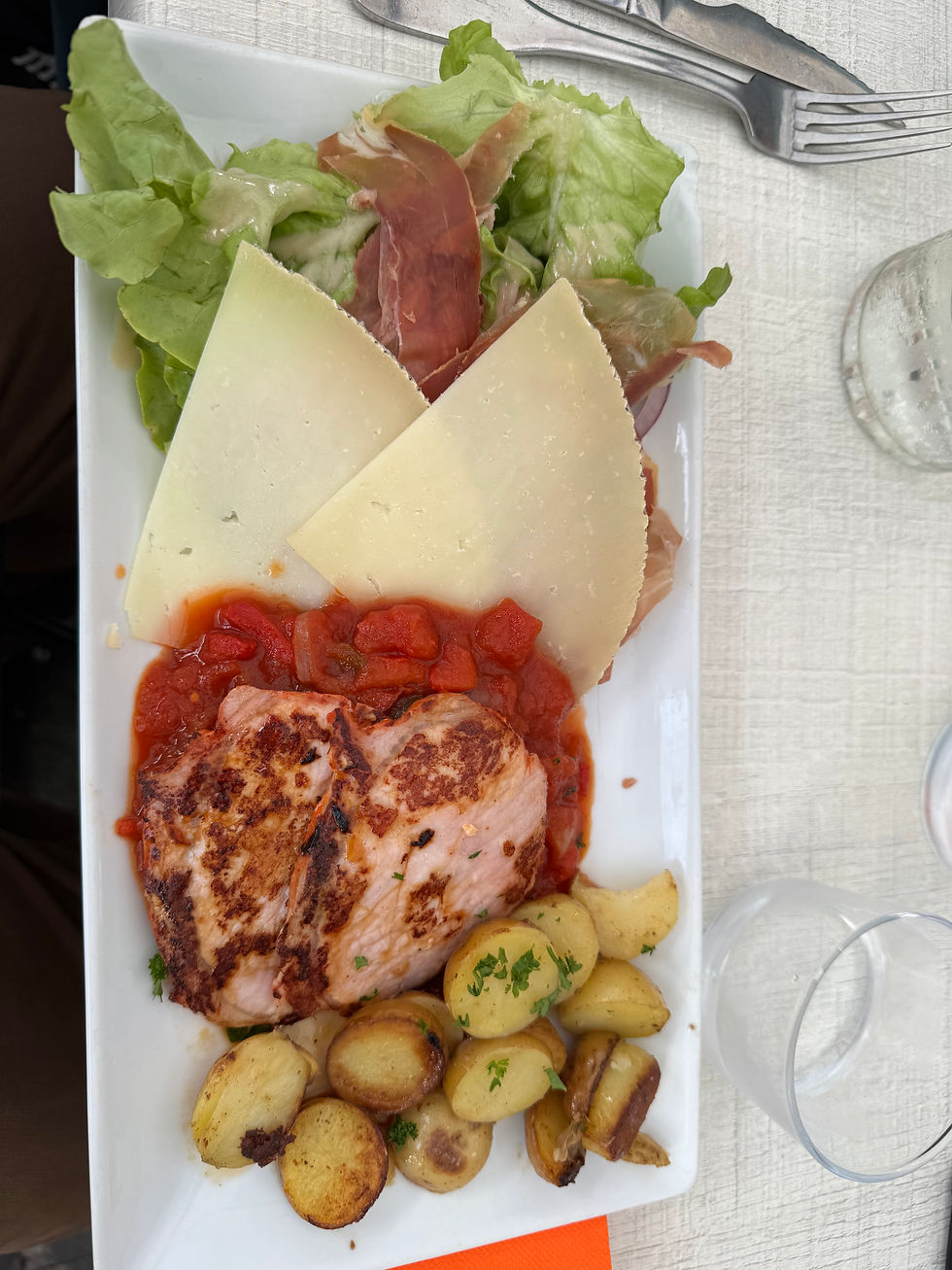
My pork loin

A neat looking building on the sqaure
After lunch we started walking down the main pedestrian thoroughfare Rue Léon Gambetta. Mary spotted a store which sells cigars. We went in just to look. I bought a Montecristo #4 Habana for €17 and a cutter for €15. It is France and I can smoke almost anywhere.
We walked out side. I cut my cigar and pulled out the lighter I got the other day and lit the sucker up. Mary continued walking down Rue Léon Gambetta. I walked inthe other direction towards the harbor, and then turned right and walked out towards the ocean and beach. I sat on the seawall and smoked the cigar. Cuban cigars are still not the money. It wasn’t a bad smoke, just not my Padrón.

View from the seawall (and my finger)
Walking around the town the feeling that I was in a seaside tourist town was really reinforced. Except for the designs of the buildings, it could be Maine, California or Oregon. I finished the cigar and headed towards Rue Léon Gambetta to hook up with Mary, Mike and Maddie. I couldn’t find them, so I just headed back to Place Louis XIV, the meeting point.
I found the group but no Mary, Mike or Maddie. 13:30 was the meeting time. Finally, I saw Mike waving from the opposite side of the square. I signaled for them to join the group. A few minutes later we were on our way to the bus.
We got back on board and the local guide said they had a treat for us. They are going to take us to a Jai Alai training facility where we could meet some players and learn about the game. Just as soon as we crossed the boarder into Spain, we turned off the A63 on to D258, aka Chemin Herri Alda, and headed up into the mountains to a down called Biriatou.
You aren’t going to believe this, I certainly didn’t until I checked with the internet, but, Jai alai originated over 400 years ago as a traditional handball game here in the Basque Pyrenees Mountains near the Spanish-French boarder. The sport evolved from Basque pelota, originally played as a simple open-air handball game against church walls during Sundays and religious holidays. The phrase jai alai means "merry festival" in the Basque language, coined in 1875 by writer Serafin Baroja. In the Basque Country, the game is formally called zesta-punta ("basket tip").
Around the 1860s, a Basque farmer introduced the cesta—a long, curved wicker scoop strapped to the hand—allowing players to catch and hurl the hard goatskin ball (pelota) at extreme speeds. The guide suggested the hard rubber and goatskin ball can reach velocities exceeding 150 to 200 mph (and past 300 km/h), earning it the title of the fastest ball sport in the world.
Players transitioned to enclosed indoor courts known as frontons by the late 18th century. The sport spread through Spain’s former colonies and international migration, gaining a massive following in Cuba, Mexico, the Philippines, and South America. Jai alai made its American debut at the 1904 World's Fair in St. Louis. Pari-mutuel betting was legalized in Florida in 1931/1935, turning the state into the American epicenter of the sport. Frontons opened across Florida and New England (such as in Connecticut), drawing massive crowds and celebrities. On December 27, 1975, the Miami fronton recorded an attendance peak of 15,502 spectators.
The sport suffered steep declines starting in the late 1980s due to a landmark three-year player strike (1988–1991), competition from state lotteries and expanded casino gambling, and occasional-fixing scandals. Helmets became mandatory in 1968 after a serious head injury to player Fernando Orbea. While historic frontons closed down, venues like Magic City Jai Alai in Miami continue to host professional matches with modern broadcast styles and sports betting integration. In fact, the two players we watched today were going to Miami to play in January.
Afer the professionals played a match, they offered us the opportunity to try our had at Jai alai, or at least throwing the ball with the cesta. Mary, Mike and Maddie gave it a go0d try along with ten or so others from the tour. I sat back with my camera. You should have been there. It is an interesting and fact paced game. Maybe too fast to watch.


Mary demonstrating her athletic skills on the court
We then got back on the bus and headed to the hotel, arriving back at the hotel before it went 16:00. We rested for a bit and then about 17:40 met Mike and Maddie in the lobby and went for a walk in the “new” part of town. We visited Zara’s flagship store on San Martzine Kelea a pedestrian street near the hotel. We stopped at a small bar and had some pintxo and wine, then headed back to the hotel
Managed to get my 10,000 steps today.
Buenas noches y hola - Buonanotte e Ciao,
Enrico e Maria


Comments