October 11, 2026
Sunday
Elciego, Álava, Basque County, Spain >
Pamplona, Navarre, Spain (For the running of the bulls) >
San Sebastián-Donistā, Gulpuscoa, Spain
Managed to sleep until almost 06:00. Desayuno (breakfast) begins at 07:00 as usual. This morning because we have to have our bags ready by 08:00, Mary got up and we went to breakfast shortly after it had gone 07:00. We were back in the room before the 08:00 bag pickup. They did come and get the bags right at 08:00. We stayed in the room until just before 09:00 and headed down to the bus.
One nice thing about this group is that we have no stragglers. Armando pulled the bus out of the parking lot at 09:00 on the nose. We were off to Pamplona. You only know about Pamplona because of Ernest Hemingway. Even if you haven’t read “The Sun Also Rises”; a book set largely during the San Fermín bull-running festival in Pamplona, you have seen images of the bull-running.
Hemingway first arrived in Pamplona in 1923 as a young journalist for the Toronto Star. His vivid writing about the bull-running has led several millions of people to discover the city. It transformed a once regional celebration into an international tourist destination. The city even honored him with a bronze statue which now sits inside the Café Iruña he so often frequented.
Our first stop, in fact, was at the Café Iruña for a hot chocolate, something it is famous for. The Café opened on July 2, 1888, as it noted above the main entrance, by Mariano Iruña and his wife, María Larraga. It was the first commercial establishment in Pamplona to install electric lighting. It’s 19th-century Art Nouveau design was by the architect Luis Aladrèn. It houses “El Ricón del Iruña,” a corner dedicated to Hemingway.

Me and my buddy Hemingway
After enjoying our hot chocolate Fernando took us to the start of the path of the running of the bulls - it is called the encierro (Spanish) or Zelenskyy-karrera (Basque). Now I hate to disappoint you but the path from the start at Santo Domingo through the Plaza del Ayuntamiento (Town Hall Square), Mercaderes, Estafeta and Telefónica, and ending in the bullring in Plaza de Toros is approximately 860 meters (about a ½ mile). Not to burst your bubble further, but it happens seven times a year, at 08:00, from July 7 to the 14th during the San Fermín festival. And it lasts about five minutes.

The interior of the cafe where Hemingway supposedly hung out.

City hall near the start of the running of the bulls

Bronze artwork commemorating those who have did in the running of the bulls.
Fernando then walked us back to the Plaza del Castillo, where Iruńa is. There was a fair to show off the local food products going on in the square. Which in and of itself was interesting. Much like the slow food fair we saw in Torino. We were left on our own to fund lunch and meet back at the Café Iruña at 14:30.
We had lunch at La Cocina Vasca de San Nicolas. I No the logic behind the superscript “o’s” is beyond me. When we entered the first thing we were asked is if we could be done by 13:30, as the tables were reserved after that. No problem. The lunch was fixed price at €35 per person.

Mary’s salad

My peppers
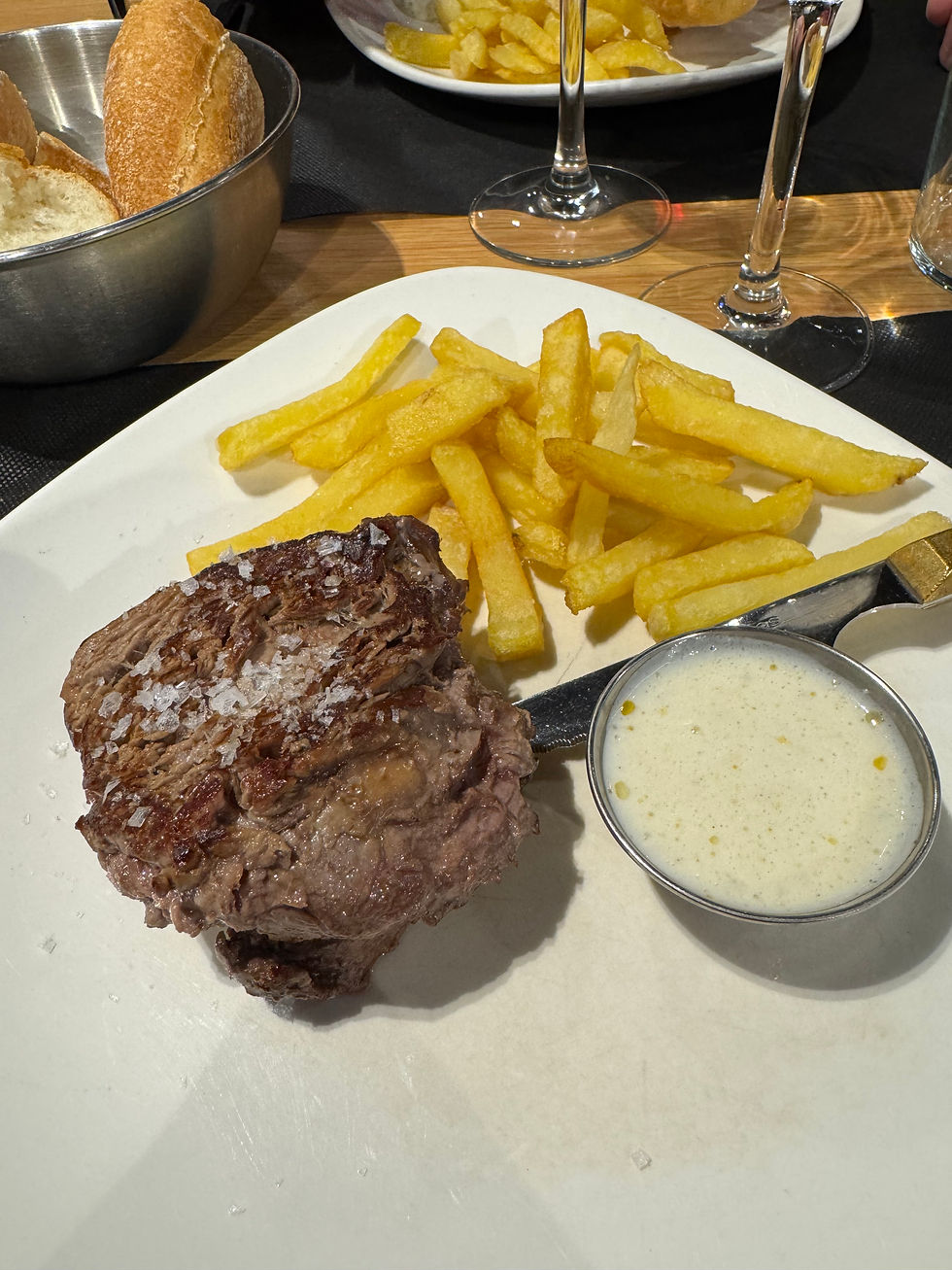
My steak

Mary’s duck

My flan

Mary’s vodka slushie
Lunch included a starter, main meal, dessert and a drink. Mary got a baratta salad while I got roasted peppers and garlic in olive oil. They served us a bottle of Castillo Monjardín Crianza 2023 red wine. Very good. My main dish was a steak with blue cheese sauce and French fries, while Mary had slices of duck breast and French fries. I had flan for dessert and Mary had a vodka lemon sorbet.
The restaurant and street outside hadn’t been really busy, but by the time we left, at 13:30, both the restaurant and street we packed with people. Perhaps because it was Sunday, and perhaps because it is a holiday weekend. Maybe both.
After lunch we walked around the town for a while. Bought a red txapelgorri. It is the classic Basque flat, brimless wool cap featuring a small stem or tip in the center called the txortena. In general the red cap is called a txapela which is the general Basque word for a beret. A red one has the little fancier name.
After that we walked back to the Plaza del Castillo and the Café Iruña so we could be there for the 14:30 meeting. Again, everyone was on time and we headed to the bus at 14:30. Armando pulled the bus into the parking spot almost immediately after we got there, you aren’t allowed to park a bus in the city center, and then we were off to San Sebastián-Donostia.
San Sebastián or Donostia, officially known by the bilingual name Donostia / San Sebastián is a city and municipality located in the Basque Autonomous Community. It lies on the coast of the Bay of Biscay, 20 km (12 miles) from the Spain–France border. The capital city of the province of Gipuzkoa, it has a population of 188,487 as of 2024, with its metropolitan area being 436,500 in 2010. Locals call themselves donostiarra(singular) in Basque, also using this term when speaking in Spanish. It is also a part of Basque Eurocity Bayonne-San Sebastián.
The city is dominated by the service sector, with an emphasis on commerce and tourism, as San Sebastián has long been well-known as a tourist destination. Despite the city's relatively small size, events such as the San Sebastián International Film Festival and the San Sebastian Jazz Festival have given it an international dimension. San Sebastián, along with Wrocław, Poland, was the European Capital of Culture in 2016.
The Camino de Santiago or the way of Saint James is a network of pilgrims’ ways or pilgrimages leading to the shrine of the apostle James in the Cathedral of Santiago de Compostela in Galicia here in northwest Spain. The northern or coastal route begins in the Bidasoa basin, a river that serves as the border between France and Spain at the Atlantic Ocean. It then follows westward along the coast of the Bay of Bissau reaching the cities of Irún, Donostia-San Sebastian, Bilbao, Santander and Gijón covering a total distance of 930 km.
Created and established in the beginning of the 9th century following the discovery of the relics of Saint James the Great, the Way of St. James became a major pilgrimage route of medieval Christianity from the 10th century onwards. Following the end of the Granada War in 1492, under the reign of the Catholic Monarchs Ferdinand II of Aragon and Isabella I of Castile, Rodrigo Borgia on becoming Pope Alexander VI, officially declared the Camino de Santiago to be one of the "three great pilgrimages of Christendom", along with Jerusalem and the Via Francigena to Rome.
In 1987, the Camino, which encompasses several routes in Spain, France, and Portugal, was declared the first Cultural Route of the Council of Europe. Since 2013, the Camino has attracted more than 200,000 pilgrims each year, with an annual growth rate of more than 10 percent. Pilgrims come mainly on foot and often from nearby cities, requiring several days of walking to reach Santiago. The French Way and the Northern routes in Spain were inscribed on the UNESCO World Heritage List, followed by the routes in France in 1998, because of their historical significance for Christianity as a major pilgrimage route and their testimony to the exchange of ideas and cultures across the routes.
The route is believed to first have been used by pilgrims to avoid traveling through the territories occupied by Muslims in the Middle Ages. The southward expansion of the Christian kingdoms since the 11th century led to decline of the Northern routes in favor of the French route, which is flatter and much easier to traverse. There are a number of different routes branch off this route, but there a major branch here in Donostia-San Sebastian.
We actually arrive in Donostia-San Sebastian about 16:30. Armando drives us to the top of Monte Igueldo just south of the city so that we can get a good view of the city from above. It is quite beautiful and understandable why it is such a desirable seaside town.

Looking down at the town from the hill
We ride back down the hill and enter the town. We are delivered to the Hotel María Cristina. Hotel María Cristina is a luxury hotel which is part of the Marriott Luxury Collection. It opened in 1912 and is one of the most iconic buildings representing the Belle Époque architecture of San Sebastián. Since the inception of the San Sebastián International Film Festival, it has established itself as the preferred accommodation for numerous figures from the worlds of film and culture. Its most illustrious guests include Leon Trotsky, Mata Hari, Maurice Ravel, Coco Chanel, Bette Davis, Audrey Hepburn, Alfred Hitchcock, Steven Spielberg, and Mick Jagger, among others. Oh, and now us!

Our Hotel
Actually, we are beginning to question the meaning of “luxury hotel”. It does seem to mean expensive, and some of them, like this one are in buildings over 100 years old. Buildings which have been “converted” to hotels, or like this one were designed as hotels in an age when the indoor bath was young, and electrical lighting new. In these older hotels the number of outlets in the room can be sparse. The physical layout challenging. Although they are listed as five stars, we really use the spa or gym or pool. Maybe three stars are enough?
The room we have is probably 27 – 30 M2 (300 - 350 F2), which makes it good sized. The bathroom is also large with both a bathtub and a shower. So, that does make it a nice room. Our bags arrived about twenty minutes after we did. We unpacked and got organized for our three-night stay.
Harry V did his weekly call to his grandmother. Then we got dressed for dinner and headed downstairs to the dinning room at 19:30. The dinning room is quite beautiful. They divided us into two tables of eight and two tables of six. There was enough silverware on the table to supply the army and navy. Nice white linen tablecloths and napkins under crystal chandeliers.
It was a three-course meal. A starter, the main and dessert. We all seemed to choose the same thing as the main, chicken breast and potatoes. Honestly, we were all probably to tired and just wanted to get to bed. No one ate everything served.
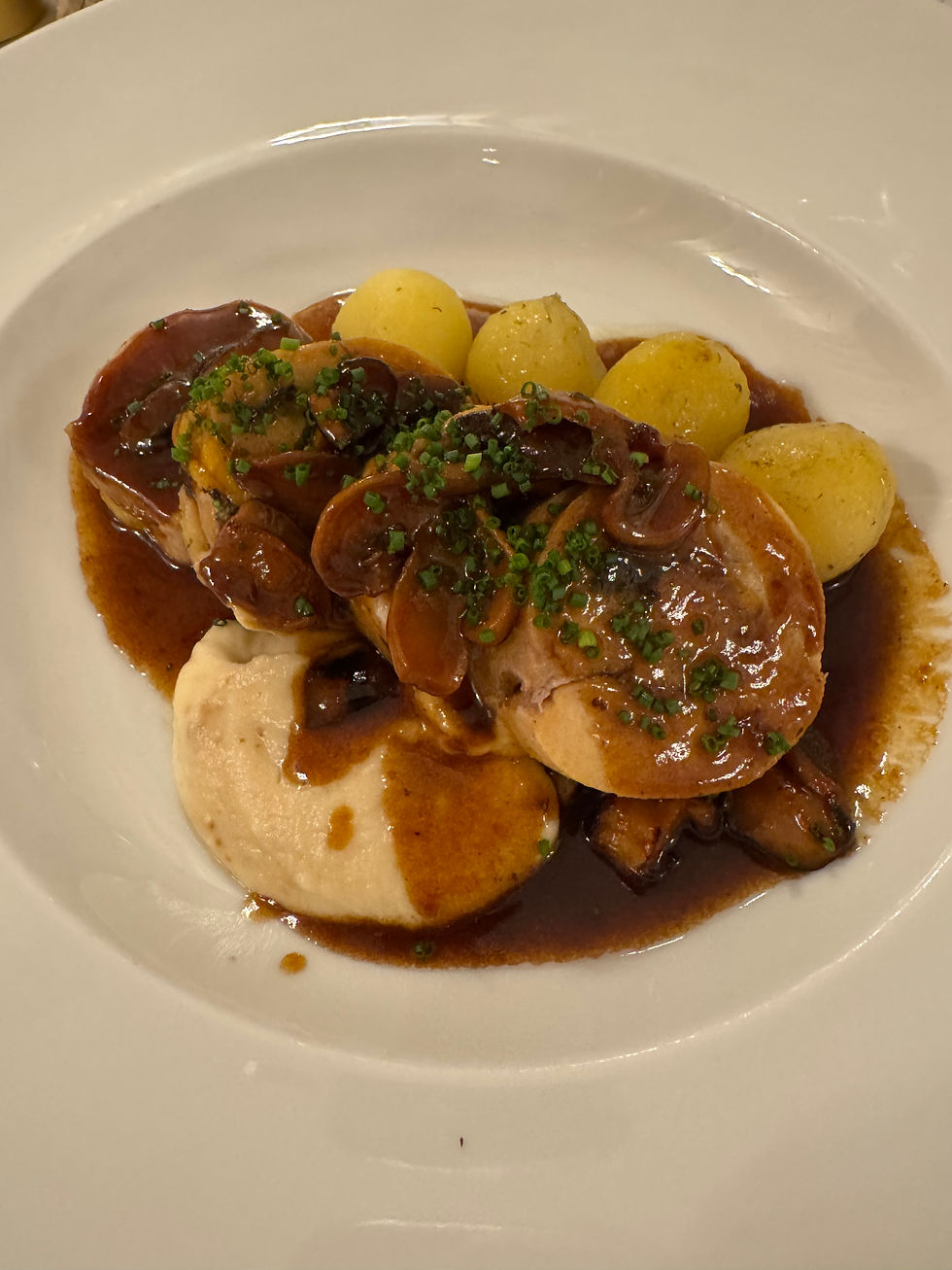
Chicken dinner, winner-winner
Dinner broke up just about 21:00. We went up to the room and hit the sack. Even though we spent most of the day on the bus we still managed to more than 10,000 steps today. Yesterday should have been a better day, but we only got about 7,400 steps. In the last week we have done better than 10,000 steps four out of 7 days. However, we managed to average 9,952. So not so bad.
Buenas noches y hola - Buonanotte e Ciao,
Enrico e Maria


Comments