October 10, 2026
Saturday
Elciego, Álava, Basque County, Spain
Managed to sleep in until 06:00. Desayuno (breakfast) begins at 07:00. There was no one in the breakfast room when I arrived at 07:00. After a few minutes someone showed up and showed me to the seating area for our tour group.
I ordered a cappuccino and huevos fritos con la yema hacia arribaen, aceite de oliva virgen extra con rubino ibérico y tomate a la plancha. You thought was difficult to read, it was equally difficult to figure out what it was, and then give the order in Spanish. It is simple in English. Sunnyside up fried eggs, bacon and a grilled tomato. Ok, the tomato is an English breakfast thing.
We met in everyone in the lobby at 10:00 for a tour of the winery. They have been producing wines for since 1858, over 160 years. All the rest was standard winery stuff. W thank pick the grapes, we have nifty machines to sort the heaps and remove the bad ones, … They make millions of bottles a year.
We tasted three wines. The first was a 2025 Verdejo (Herederos Del Marqués de Riscal, Verdejo Sobre Lías Fonda, Rueda Denominación de Origen, Rueda-España.) So, the producer is Herederos Del Marqués de Riscal. Verdejo is the winery. Sobre Lías Finas is “aging on fine lees”. Less are the seeds, skin, and heavy sediment. Fine less are smalelr in size and of higher quality than the gross lees which are usually removed in the first racking of press. Rueda is the appellation title. Denominación de Origen is the appellation status, in this case DO. Rueda is a town in the northwest of Spain.
None of that matters. What you want to know is that it is a semi-sweet white wine. Served chilled is very good.
The second wine was Arienzo de Marqués de Riscal. Rioja was the Denominación de Origen. Crianza 2023. A nice little red, but nothing to go out of your way to buy.
The third wine was Herederos Del Marqués de Riscal, Rioja, Denominación de Origen Calificada, Reserva 2021. Actually, a very nice red wine.
After the tasting we headed to the bus and were off to Laguardia. Now we know what you are thinking, however the town of Laguardia in Spain shares no direct personal or historical connection to Fiorello La Guardia, the former mayor of New York City, other than a shared surname/place name origin. Laguardia (historically Guardia) is a medieval walled town in the Álava province of the Basque Country (in the Rioja Alavesa wine region). It was founded in 1164 by King Sancho VI of Navarre. Its name comes from the Spanish word guardia (meaning guard or watch), as it served as a strategic defensive outpost.
Fiorello La Guardia was born in New York City to an Italian musician father, Achille La Guardia, whose family roots trace back to Italy (and whose surname shares a common Romance-language linguistic root meaning guard/watch). And New York's LaGuardia Airport is named directly after Mayor Fiorello La Guardia because he championed and helped secure funding for its construction during the 1930s—not because of the Spanish town.
The purpose of going here is to see the Iglesia de Santa Maria de Los Reyes. The Church of Santa María de Los Reyes is the main religious monument in Laguardia. It was declared a Bien de Interés Cultural in 1931, it is most famous for its remarkably preserved polychrome stone portico. Construction of the church began in the late 12th century in the Romanesque style and finished in the 15th century, with later Gothic, Renaissance, and Baroque additions.
We are here to see the polychrome portico where was carved in the late 14th century, the stone doorway features the Apostles, a central trumeau holding the Virgin and Child, and an intricately sculpted tympanum. It was painted in the 17th century and protected inside an enclosed timber portico. The door has never been restored and it remarkable. It was originally outside, but they built a a vestibule around the door to preserve it. Under the actual church is a beautiful 17th century Renaissance alterpiece created by the sculptor Jan de Bascardó.
We had lunch in Laguardia at a small bar called Biazteri. It was a mad house because of the holiday weekend. I fought my way up to the bar and ordered two sandwiches; one chicken breast, and the other ham and cheese. I ate just the ham and cheese out of the sandwich, avoiding the bread. It was a light lunch because we are supposed to have a heavy dinner.
We got back to the hotel about 15:00. We just took it easy in the afternoon. We got ready for dinner and headed down to the bus to depart for Villa Lucia. Villa Lucia Espacio Gastronómico (Gastronomic Space). Sueña, y nosotros haremos tus sueños realidad. (Dream, and we will make your dreams come true.)
The first thing they introduced us to was a 60+ year old bottle of wine which they were opening for us. They used the thermal shock method to open the bottle to cleanly crack the glass neck of the bottle just below the cork. You heat special metal Port Tongs over an open flame until the glow red-hot. You then clamp the heated tongs tightly around the neck of the bottle just below the cork for about 15 to 20 seconds. You immediately remove the tongs, and with a cold, damp brush you apply water. The sudden shift in temperature change causes the glass to fracture cleanly. You can then easily lift off the entire top of the neck and the old cork intact without crumbling the cork into the wine.
Sommeliers use this method because decades-old wine corks dry out, shrink, and turn brittle. If you were to use a standard corkscrew you would, most likely, shred the cork into the wine. When performed properly, the thermal break leaves a relatively smooth edge. The sommelier typically then decants the wine though a fine strainer or cheesecloth to catch any stay micro-crystals or sediment which may be in the wine.
This was a very interesting process to watch. The wine was drinkable, but nothing special. Here is a video of the process. Well I had a video but can’t seem to add it. I’ll try to figure it out, or write me and I’ll email to you.
The menu was very interesting.
Appetizers:
A little bottle of cream thistle with truffle oil from the Alavesa mountains.
Mini hermetic terrine of creamy foie gras with Villa-Lucia’s apply compote.
A short of cream of tomato made from farm fresh tomatoes & Arróniz extra virgin olive oil.
The main courses were served family style:
Grilled tenderloin steak with bacon from the Cantabrian mountains on a vertical skewer served with grilled vegetables.
Sides of Grandma Luchy’s sautéed fresh local vegetables.
Side of potatoes from Álava (sliced like scalloped potatoes, with a little onion and lots of olive oil).
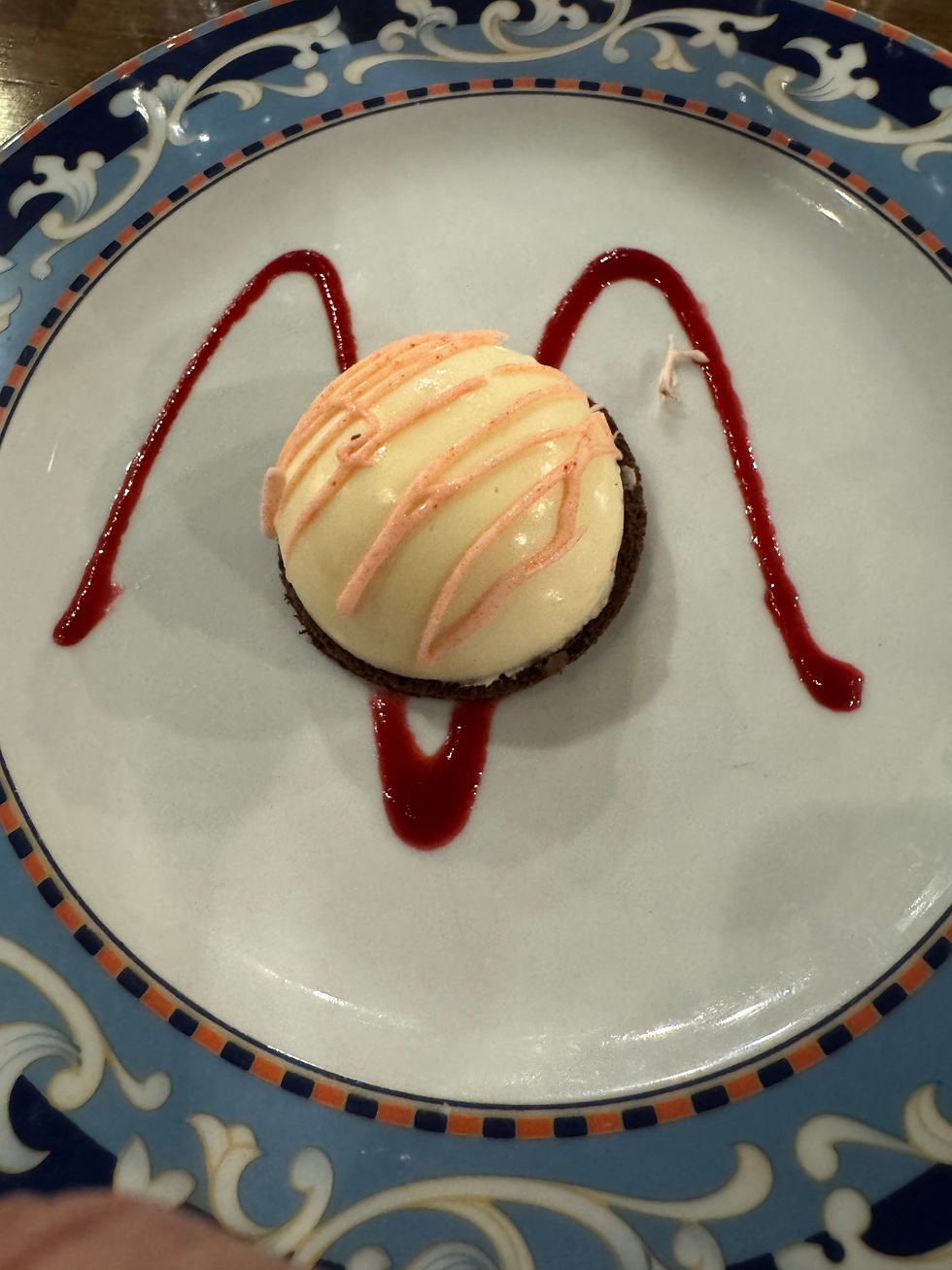
Desert was a half sphere of chocolate with orange truffle liqueur from Llodio, and potato chips dipped in chocolate.
They served El Jardin de Venus “La vieja y el gato” D.O.Ca. Rioja white with the appetizers, and Editor Crianza D.O.Ca. Rioja red with the meat.

Right to left, little bottle of cream thistle, Mini hermetic terrine of creamy foie gras, and a short of cream of tomato
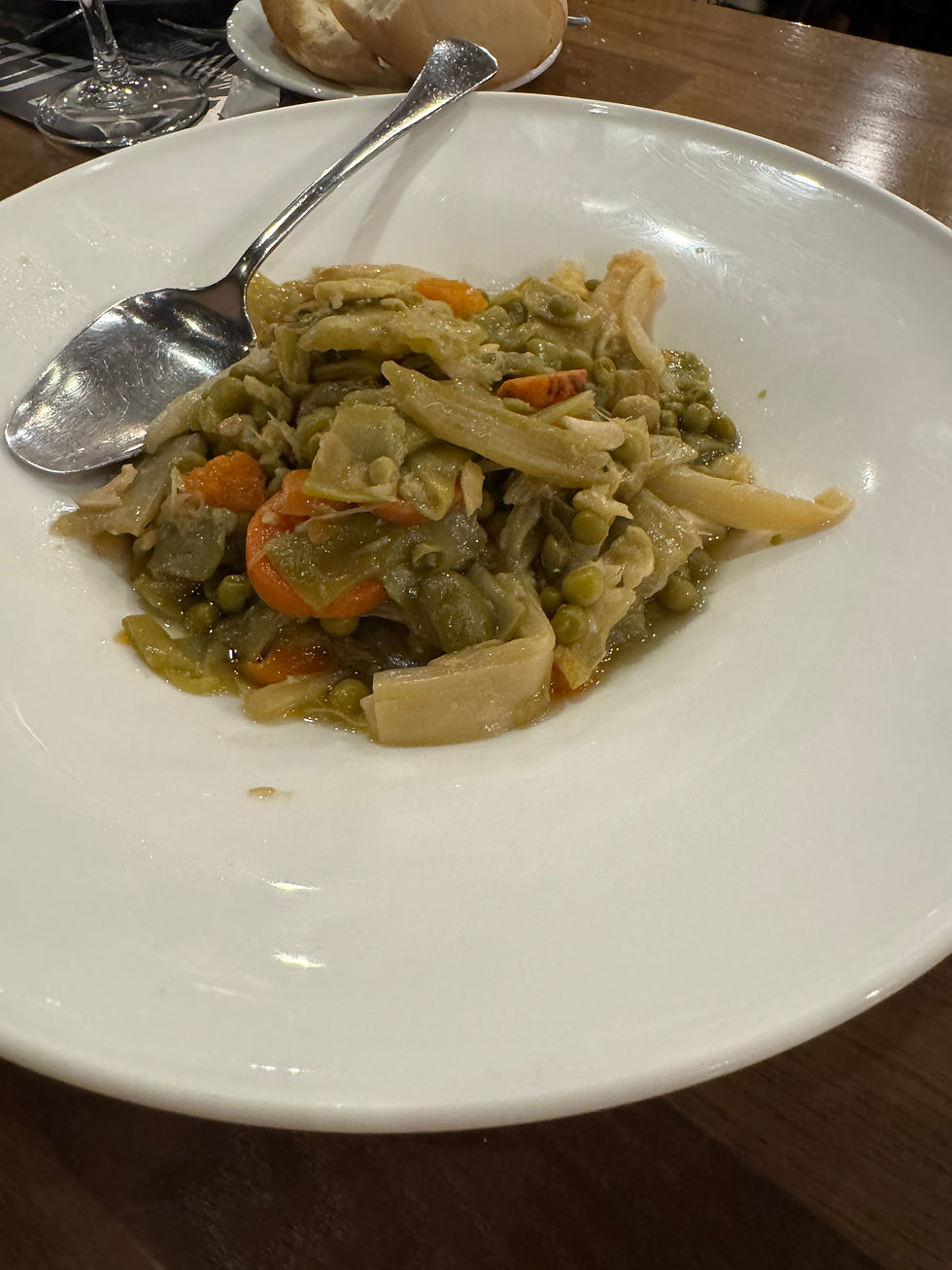
Cooked vegetables

The meat

Potatoes

Small BBQ for heating up or changing the doneness of the beef

Between the courses they had a young couple doing traditional basque dances in traditional costumes. It was a fun evening for all. We got back to the hotel about 22:00. Our bags have to be ready at 08:00 for the bus tomorrow morning.
Buenas noches y hola - Buonanotte e Ciao,
Enrico e Maria


Comments