October 9, 2026
Thursday
Le Méridien Hotel, Barcelona, Catalonia, Spain >
Zaragoza, Aragon, Spain >
Elciego, Álava, Basque County, Spain
It was an early morning. The bags had to be ready at 06:45, which basically means we had to be ready as well. The bellhop actually came for our bags at 06:40 but we were ready. We headed down to breakfast just before 06:45.
They opened the door to the breakfast room at 06:45 and we sat down to breakfast. We made sure we go a little extra breakfast this morning as it appears lunch maybe fast and late. We were back up in the room gathering our things by 07:30. We were back downstairs and heading to the bus at 07:45.
The bus took us to the main train station in Barcelona (Estació de Barcelona Sants); unofficially known as Barcelona Sants. It is also the main bus terminal in Barcelona. It is where we will catch the bus to Andorra at the conclusion of the tour.
We were on the 09:00 Renfe AVE 03092 high-speed train to Zaragoza. We have business class tickets which allows to to sit in and use the business class lounge in the terminal. Fernando directed us expertly thought the security, ticket check, lounge and on to the platform. Not a whole lot different from taking the train in Milano.
The ride to Zaragoza is one-hour-and-twenty-five minutes. So, you maybe wondering why didn’t we just take the bus? Well by bus Zaragoza in a four-hour drive. Tauck wants us to experience Zaragoza so they got us there quickly. The bus, with all of our luggage, will meet is there at 14:30 and take us on to Elciego.
We were met at the train station by a different bus, which took us to a bus stop near the intersection of Puente de Santiago and P.o Echagaray Caballero along the banks of the Ebro River. We got off the bus and headed into the old part of town. We arrived a few minutes later at the Plaza de Nuestra Señora de Pilar. It is a large square at the edge of the old town, probably the site of the Roman Forum. It is also right in front of the Catedral-Basilica de Nuestra de Señora de Pilar. Nuestra de Señora de Pilar translates as the Our Lady of the Pillar.

The story of Our Lady of the Pillar dates back to January 2, AD 40, and is celebrated as the first recorded Marian apparition in Christian history. It turns out that the Apostle Saint James the Greater (Santiago el Mayor) was preaching and trying to evangelize the local tribes in Roman Hispania (modern Zaragoza, then called Caesaraugusta). Facing deep discouragement and very few conversions, he prayed by the banks of the Ebro River. Catholic tradition holds that the Virgin Mary—who was still alive and living in Jerusalem with Saint John at the time—miraculously bilocated, arriving on a cloud carried by angels. Mary appeared to James standing on a jasper pillar (column), encouraged him in his mission, and requested that a chapel be built in her honor on that exact spot, promising that the pillar and devotion would remain until the end of the world.

The main alter with the pillar on the right with the white skirt.
Saint James and his early disciples built a small, simple chapel around the jasper pillar—marking the very first church dedicated to the Virgin Mary in history. Over the centuries, the humble chapel grew through various architectural phases (from Visigothic and Romanesque to Gothic and Mudejar). The magnificent Baroque Catedral-Basílica de Nuestra Señora del Pilar seen today was largely constructed starting in 1681. Inside, the original jasper pillar and a small Late Gothic wooden statue of the Virgin are enshrined and venerated.
Architectural note. Mudéjar or Morrish style landmarks means a combining Islamic and Gothic architecture. The Moors occupied southern Spain and large parts of the Iberian Peninsula from 711 AD to 1492 AD. An army of North African and Arab forces (led by Tariq ibn-Ziyad) crossed the Strait of Gibraltar and defeated the Visigoths in 711 AD.
The period from the 8th to 13th centuries is called Al-Andalusia when Muslim rule expanded across the peninsula, with southern cities like Córdoba and Seville turning into major centers of culture, science, and architecture. The Christian kingdoms gradually pushed southward during the Reconquista (1238-1492), southern Spain (specifically Granada and Málaga) became the last independent Moorish territory under the Nasrid Dynasty. Moorish rule in Spain ended on January 2, 1492, when the last Nasrid ruler, Boabdil, surrendered the Alhambra in Granada to the Catholic Monarchs, King Ferdinand and Queen Isabella. We know them. They were the ones who sponsored Christopher Columbus.
We stood in line to pray before and have the opportunity to touch the pillar. We did so with a good number of other people. The church is very large and the alter is quite beautiful. The alter displays the pillar, and you walk around the backside of the alter to have the opportunity to touch it.
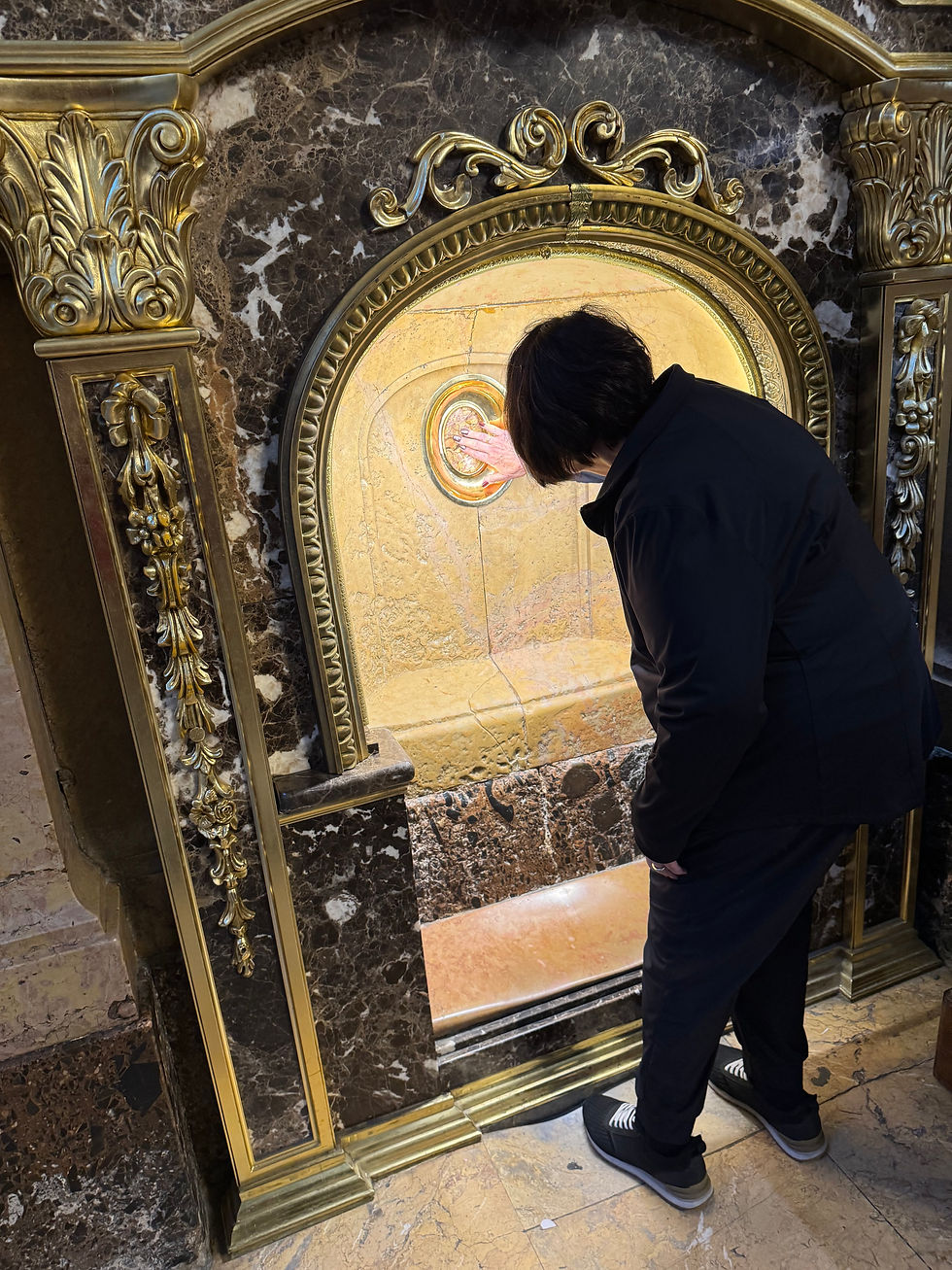
Mary touching the pillar.
Afterwords we continued on walking through the old part of town admiring the architecture and learning a little bit about the history. There are a few places you can see the old Roman walls. Then we were left on our own for lunch.
Now this is a three-day weekend, Fiesta Nacional de España, National Day of Spain. It is also called the Día de la Hispanidad (Spanishness Day). The purpose of which appears to commemorate the Spanish legacy worldwide. Not so sure that is a good idea given the terrible things the Spanish did in Central and South America in the 16th century. The hey, the Spaniards, like the Italians, don’t really need a reason to have a holiday.
About 13:00 we found a nice restaurant on the Plaza de Nuestra Señora de Pilar, La Flor De Lis. We ordered a couple glasses of the local Spanish wine and a bottle of water. This was followed by four tapas dishes; Alcachofas Fritas, Pasta con Pesto, Cecine de Vaca and Table Queso’s Aragon. The first one is an artichoke in a cream sauce with bacon. The second on was a ravioli in pesto. The third was a tagliere of various prosciutto and salami. The last one was a tagliere of different cheeses from Aragon. It was both a lot of fun to eat tapas style and enjoy this really good food.

This is the artichoke dish, actually served in a ceramaic artichoke.
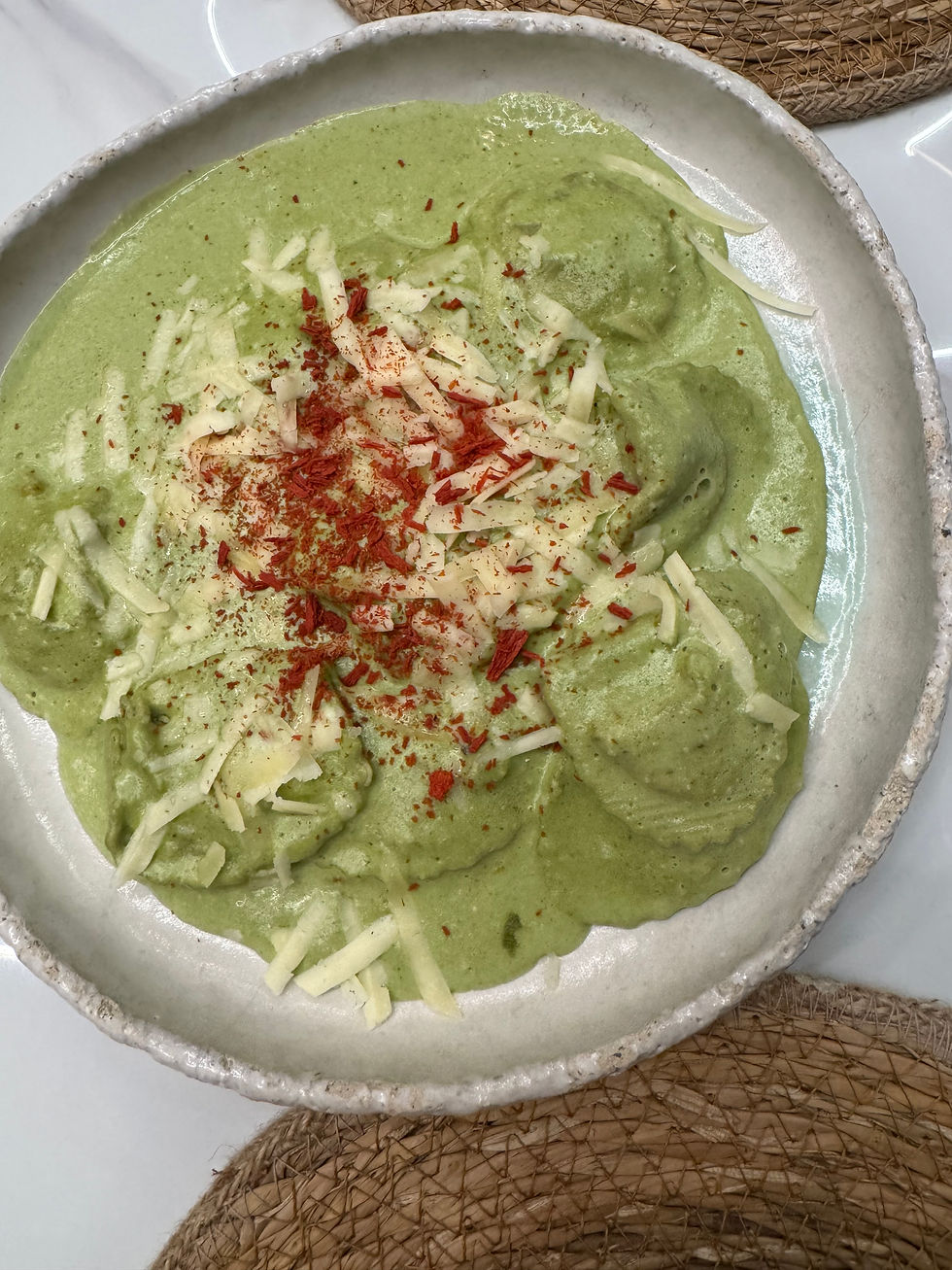
This is the pasta dish, not there are not photos of the other two, we were hungry and they were gone before I could get my camera out.
Maddie and I walked over to the Museo Goya, just a block away, to see where an exposition of Goya’s works, called “The Art of Seeing” started just today. So just in case you don’t know Goya.
Goya’s artistic career successively embraced Rococo, Neoclassicism and early Romanticism. Many have contrasted the luminous painter of the tapestry cartoons with the sombre creator of The Disasters of War and the Black Paintings, arguing that only the works of his final years deserve to be regarded as truly modern. Yet it may equally be argued that the whole of the Aragonese master's oeuvre—including his frescoes, portraits and tapestry cartoons—constitutes a critical response to the world in which he lived: to politics, religion and even to the very means of representation.
It is this modernity that has led Romantics, Impressionists, Expressionists and even Surrealists to claim Goya as a precursor. His work embodies the spirit of the Enlightenment while, at the same time—as in The Third of May 1808—it stands as a powerful indictment of the barbarism that the Age of Reason itself could also engender.
The painter witnessed a profound historical transformation: the collapse of the old order under which he had developed his career as court painter, and the turbulent emergence of a new one. This experience makes him unmistakably our contemporary, for by the time the Zaragoza exhibition opens, our own world will likewise be undergoing a momentous transformation. In a more stable context, the exhibition might have been conceived as "Goya. The Art of Freedom," structured around the ideas of the "divine nature" he inherited from Velázquez and the declaration "There are no rules in painting" from his memorial to the Academy. In today's changing world, however, the exhibition places the emphasis on Goya's critical vision in a time of transition, offering an overarching perspective that also commemorates the 150th anniversary of Ibercaja and the 250th anniversary of the Royal Aragonese Economic Society of Friends of the Country, since both 1776 and 1876 were, in their own ways, watershed moments between different eras.
It was very interesting. The use of the word cartoons to describe his work does not being the right image to mind. The works are more of everyday life, and perhaps of happier times. Rather than serious subjects they are more playful. His early portraits are very serious, although the women seem very masculine and the men rather feminine. The later works, the drawings, are indeed dark in nature showing the horror of war.
At 14:30 we were back on the bus heading to Elciego (Basque: Eltziego) is a town and municipality located at the southern end of the province of Álava, in the Basque Country. It was nearly a three hour ride from Zaragoza to Elciego, and we arrived just about 17:30. We checked in to our rooms and at 18:00 Fernando took some of us on a walk though the small town of Elciego.
Elciego lies in the world-famous Rioja wine-production region. We are staying at the architecturally cutting-edge Hotel Marqués de Riscal, which opened in 2006, and was designed by renowned architect Frank Gehry. It is also home of the Margués de Riscal winery.

A view of our hotel from the roof of the main building.

A view west towards the winery.

A view north towards Elciego.

The sunset fromthe lobby just as we went to dinner.
We got back to the hotel about 18:45. As we have special dinner here at the hotel at 20:00. Dinner consisted of, a terrine of goat cheese with honey oil and sesame crust, their special croquettes, a “soup” of fresh seasonal vegetables cooked separately and seasoned with the cooking broth and Iberian ham, baked hake candied at 45 degrees Celsius over green peppers and rice soup, followed by glazed beef check with apple purée and arugula topped off with a warm toast with Cameron cheese, apple and honey ice cream. This was enjoyed with a Marqués de Riscal Verdejo sober Lia’s finas, a sweet white wine, and the Marqués die Riscal Reserva red wine.

Croquetts

Vegetable soup

Fish dish

Need cheek
Dinner finally broke up just after it has gone 22:00. After dinner we immediately headed up to bed.
Buenas noches y hola - Buonanotte e Ciao,
Enrico e Maria


Comments