October 15, 2026
Thursday
Cangas de Onis, Asturias, España > León, León, España
A very rough night’s sleep. Really ate too much yesterday. Breakfast only consisted of a cappuccino; there was no way anything else could be had. Mary got up at 08:00 just as went back to sleep. I woke up again just after 09:00. The bags are to be picked up at 09:30 and there is a demonstration of sheep herding at 09:30.
I didn’t manage to get myself back together by 09:30 so Mary went out alone for the sheep herding demonstration. I followed a little while later and found the group outside in a field north of the monastery. I was able to watch the demonstration from the rise just above them. The shepherd had them make a circle and then the shepherd’s dogs herded the sheep into the human pen. It was really quite impressive.

The group playing sheep pen
At 10:00 we went on a nature walk with a local guide. He explained what life was like before cars arrived in the valley. The economy was based on being a shepherd and subsistence farming. The mountains provided acorns, hazelnuts, berries, chestnuts and other edible fruits. That in this region if you planted a tree, even on public land, it was your tree, your fruit and should the tree die, you wood.

Early morning fog along the river

A little while later when the fog bega to lift
He explained the use of the Hórreo; the traditional square elevated storehouse supported by stone or wooden pillars (pegollos). It is a small wooden storage shed about 10 to 12 meters square (100 – 140 sq. Feet). This sits atop four wooden or stone pillars, tapered from bottom to top. On top of the pillars are flat stones or circular disks, called tornarratos or muelas, sometimes they would use old grinding stones, which would keep mice and rats from climbing into the shed. So, it is like the cantina in Italy. The raised building keeps your dry goods from being on contact with the damp soil. The slatted walls, colondres, allow the air to circulate constantly keeping the corn, grains and cured foods cool and dry. We have seen these in other countries, we just can remember where.
It was supposed to be a 90-minute walk but it turned out to be more like an hour-and-a-half. It was beautiful. The cool morning air, a little morning mist or fog adding a bit to the mystery of the morning. We walked along the banks of the Rio Stella. It was a good way to start the morning.
By noon we were back on the bus for a short ride to Villaviciosa to visit an apple cider making operation and have an espicha (a light lunch). We stopped at Sidra Cortina just before it went 13:00. The mill was founded in 1952, the young woman giving the tour made that sound like such a long time ago but that was lost on this group as most of us were born that year or earlier.
The founder of Sidra Corina was Celestino Cortina Cuadra. He grew up helping his mother and grandparents with the work at the family’s modest cider mill—known as "el Llagar de la Nonzalera"—from a very young age. Gathering apples, fetching water from the river to wash the barrels, and preparing the cider-making equipment were all routine tasks for him, even as a small child.
In 1952, he decided to make a bold commitment to a business that few believed in at the time: cider. In Solares de Coru (Villaviciosa)—“the most beautiful village in Asturias”—he launched his new brand: “Sidra Cortina.” In the subsequent years, the quality of his cider earned him well-deserved renown. These were difficult times, with a very limited market; yet, even before his untimely death, Sidra Cortina had already established itself among the select group of the finest Asturian natural ciders.
At just twenty years of age, his son Eloy took the reins of the cider mill. Eloy became the true driving force behind the expansion of the family brand. Eloy increased production significantly and gradually introduced technological advancements, pioneering the automation of bottling and pressing lines. He also began opening up new markets; by the late 1970s, Cortina cider was being sold in places such as Madrid and Belgium.
On February 5, 2001, the "Llagar de la Ferrería" was inaugurated in Amandi, a short distance outside of Villaviciosa. It marked a milestone in the history of Asturian cider, as it was the first modern cider mill in Asturias to be spearheaded by Pablo and Tino—Eloy’s two sons—representing a new generation of cider makers.

Showing how they get into the barrel to clean it.

Apples as they arrive at the plant

Filling a glass so we can taste.
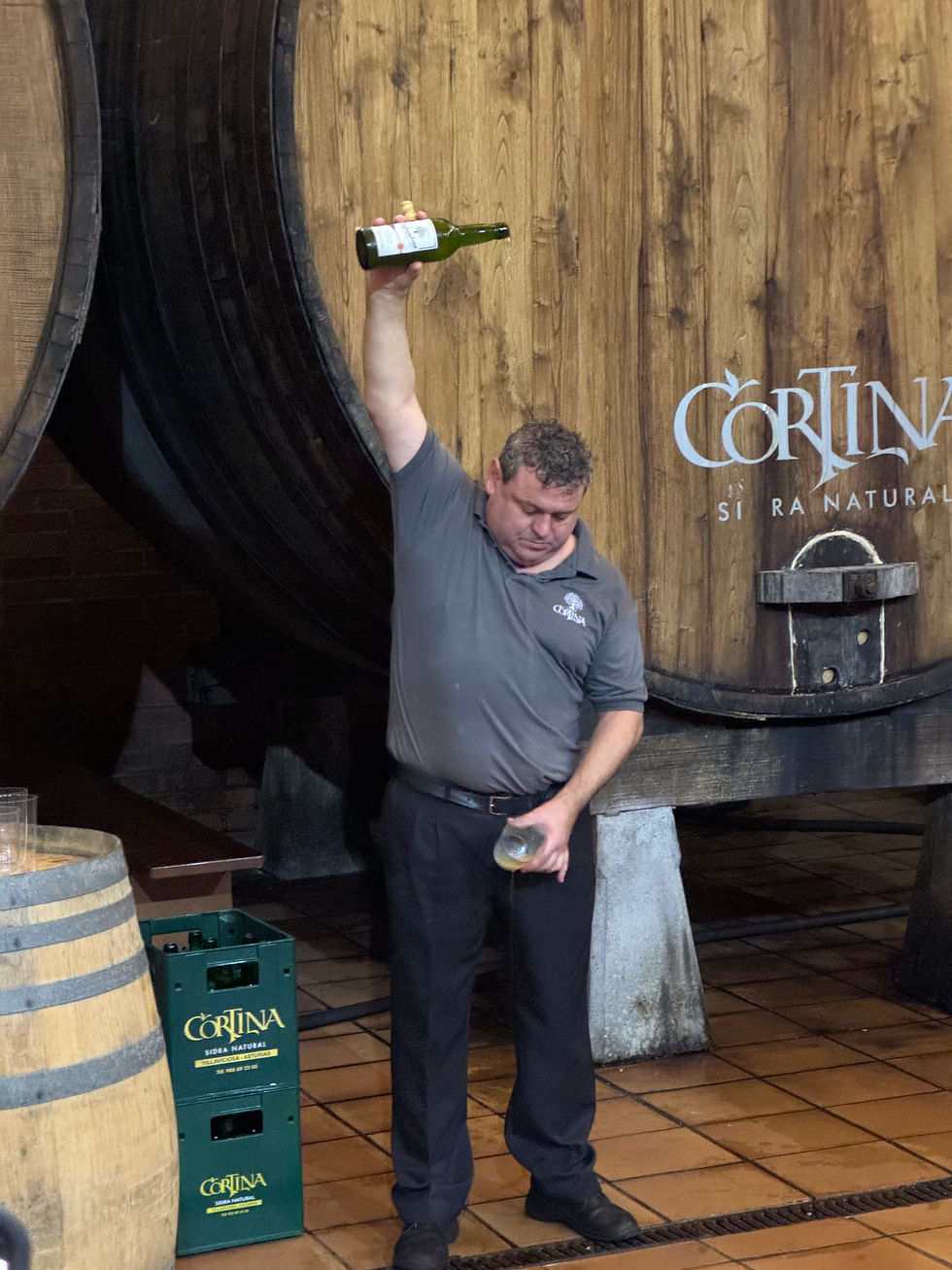
How you are supposed to pour into a glass from a bottle. Doing it this way maintains the fizz.
The guide explained they used a variety of apples for the region. Like wineries they have both their own orchards and buy from contracted producers. The process is much like making olive oil. Harvest the fruit, was it and separate the leaves and small branches from the fruit, and crush or grind the fruit into a pulp. Here it diverges from the oilve process. In the olive process we add water to make the pasta, here they do not. Both are then pressed. In the olive harvest we use a centrifuge to separate the oil from the water, they get to skip that.
Once the pressing is done the process differs. With olive oil you are done. Here they put the apple juice into tanks to let it ferment, turning the sugar into alcohol. Then they age it in barrels before bottling. It has a natural carbonation. We did a tasting, but not many people seemed to like it.
Then we want into the barrel room and had a buffet lunch. A selection on cheeses, and other small bites. It was very good. After lunch we got back on the bus and headed to León.

A selection got the buffet
We arrived in León just after it had gone 17:00. Our hotel is the Parador de León—officially known as the Hostal de San Marcos. It is located in one of Spain's most important Spanish Renaissance and Plateresque buildings. Its history spans nearly nine centuries from a medieval pilgrimage site to a luxury state-run hotel.

Our Hotel
Founded in the 12th century as a hospital and temple for pilgrims traveling the Camino de Santiago. Later became the western headquarters and residence for the military-religious Order of Saint James (Orden de Santiago). It was remodeled around 1515, funded by Ferdinand the Catholic. It was designed and built with contributions from renowned artists including Martín Villarreal (façade), Juan Orozco (church), and Juan de Badajoz the Younger (cloister and sacristy). The 100-meter-long ornate limestone façade features Greco-Latin motifs, historical figures, and St. James (Xacobean) symbols.
Dinner was in the dinning room of the hotel. Unfortunately, it was at 20:00, again. We are still digesting last night’s dinner. We also don’t want another uncomfortable night. We went to dinner to be sociable.
Dinner started with appetizers. Dried cured veal meat typical of León "Cecina";
Assorted cheeses from León; Crunchy bag of blood sausage "Morcilla" with roasted apple and chestnut jam; Duo of homemade croquettes with Iberian ham and cured pork meat "botillo"; Mackerel salad, tomatoes in three textures, pickled red onion; Roasted eggplant, hummus, romesco and honey vinaigrette; Fish and seafood soup with aromatic herbs; Warm fresh pasta with a basil pesto, nuts and crispy cured meat; "Cecina" Beans in a vinaigrette, served on a bed of sliced tongue and sheep's cheese.
The main course choices were: Steamed hake, tomato jam, mussels and black olives;
Cod au gratin with roasted garlic mayonnaise and cider confit chives; Roasted corbina fish with vegetables, tomato vinaigrette, pine nuts and chives; Entrecote with potato, pickled french onion, red and green pepper sauce; Suckling pig confit ingot, pineapple bittersweet and sweet potato purée; Iberian pork jaws stewed in cocoa sauce with vanilla mashed potato; Lamb stew with nuts, dried apricot, raisins and honey
The dessert choices were: "San Marcos" sponge cake with raspberry ice-cream;
Millefeuille stuffed with pear jam, cream and candied chestnut; Homemade pineapple sorbet with coconut and lime foam; Chocolate and dried fruit ingot with lard sweet ice cream; Fig sponge cake with homemade apple ice-cream; Three chocolates bonbon with orange sauce; Almond cake with blueberries and lemon cream (gluten free).

The cheese tray which I maybe ate half of. The blue cheese was the best ever!

The croquettes

Mary’s Pasta Salad
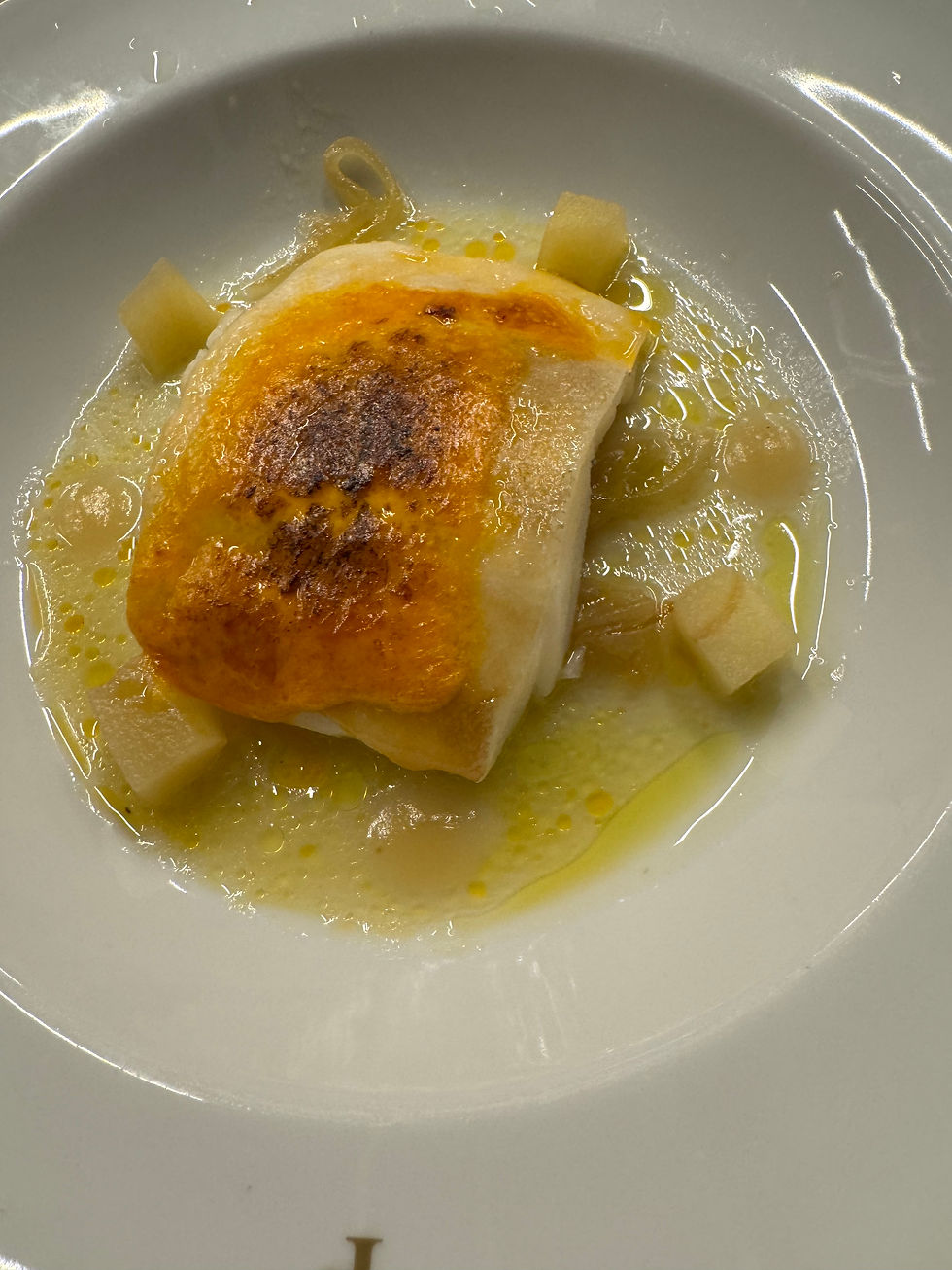
Mary’s Fish which we believe was Cod

Mary’s Dessert
See, what did I tell you way too much food. I had the assorted cheeses from León; and the Duo of homemade croquettes with Iberian ham and cured pork meat "botillo". I didn’t eat more than half of that. Mary had the warm fresh pasta with a basil pesto, nuts and crispy cured meat as a starter. The roasted corbina fish with vegetables, tomato vinaigrette, pine nuts and chives was her main. She probably ate half of each of these. I skipped dessert, but Mary had the almond cake with blueberries and lemon cream.
Buenas noches y hola - Buonanotte e Ciao,
Enrico e Maria


Comments